
This Training Material is Belong to OSHISIS Solution PLT
MS 2530:2022
Malaysian Sustainable Palm Oil (MSPO)
Practical Audit Training in the Field
INSTRUCTION
From this exercise, the participant will learn how to do on-site assessments and record audit data into the reporting process, including if any findings are classed as NC or OFI, through these group activities. Participants will also learn how to tie the MSPO clause number to the audited process and the objective evidence that was found during the audit through this exercise. What action should the group take? Note: Every conclusion must be supported by appropriate statements that clarify each explanation provided. MSPO DOCUMENTATION & IMPLEMENTATION
ONSITE AUDIT
MS 2530:2022 Malaysian Sustainable Palm Oil (MSPO)
Content
Scope Normative references Terms and definitions Principles and criteria Principle 1: Management commitment and responsibility Criterion 1: Malaysian Sustainable Palm Oil (MSPO) policy Criterion 2: New planting 4.1.3 Criterion 3: Existing site management Criterion 4: Replanting Criterion 5: Training and competency Criterion 6: Economic and financial viability plan Criterion 7: Commitment to contribute to local sustainable development 4.1.8 Criterion 8: Complaints and grievances handling Criterion 9: Internal audit Criterion 10: Management review Principle 2: Transparency Criterion 1: Communication and consultation Criterion 2: Traceability Criterion 3: Transparent and fair price dealing Criterion 4: Ethical Conduct Principle 3: Compliance to legal requirements Criterion 1: Regulatory requirements Criterion 2: Rights to use land Criterion 3: Native customary rights Principle 4: Social responsibility, health, safety and employment condition Criterion 1: Social Impact Assessment (SIA) Criterion 2: safety and health Criterion 3: Employment conditions Criterion 4: Living conditions Principle 5: Environment, natural resources, biodiversity and ecosystem services Criterion 1: Environmental management Criterion 2: Efficiency of energy use and use of renewable energy Criterion 3: Waste management and disposal Criterion 4: GHG emissions Criterion 5: Water Resources Criterion 6: Environmental conservation and protection Criterion 7: Zero burning practices This Training Material is Belong to OSHISIS Solution PLT Principles and Criteria
Malaysian Sustainable Palm Oil (MSPO)
Part 1: General Principles
1 SCOPE 2 NORMATIVE REFERENCES 3 TERMS AND DEFINITIONS 3.1 Biodiversity 3.2 Business or management plan 3.3 Category of growers 3.3.1 Independent smallholders 3.3.2 Organised smallholders 3.4 Child and Young Person 3.4.1 Child 3.4.2 Child 3.4.3 Young person 3.5 Child labour NOTE. International Labour Organisation (ILO) International Programme on the Elimination of Child Labour (IPEC)) (Adapted from ). 3.6 Competence 3.7 Contractor 3.8 Credit 3.9 Dealers 3.10 Debt bondage 3.11 Decent living conditions 3.12 Direct suppliers 3.13 Employees 3.14 Environmental Impact Assessment (EIA) 3.15 Ethical business conduct 3.16 Fair contract 3.17 Food security 3.18 Forced labour 3.19 fragile and marginal soils 3.20 Free, Prior and Informed Consent (FPIC) 3.21 Greenhouse gas (GHG) 3.22 High Conservation Value (HCV) 3.22.1 HCV Area (HCVA) 3.22.2 HCV Management Area 3.23 Human rights 3.23.1 Human rights as in the federal constitution 3.23.2 Human rights in relation to employment 3.24 human rights defenders 3.25 Land tenure 3.26 Local community 3.27 local sustainable development 3.28 native customary rights 3.29 natural forest 3.29.1 deforestation 3.30 New establishment 3.31 New planting 3.32 Non-conforming palm oil productst 3.33 Oil palm products 3.34 Operation 3.35 Organisation 3.36 Palm Oil Value Chain 3.37 Peat soils 3.38 Polluting activities 3.39 principal employer 3.40 Rainwater harvesting 3.41 Replanting 3.42 Riparian/riparian buffer zone 3.43 Social benefits 3.44 Social Impact Assessment (SIA) 3.45 Social origin 3.46 Supply chain 3.47 Sustainable development 3.48 Stakeholders 3.48 affected rights holders 3.49 Traceability 3.50 Triangular employment 4 PRINCIPLES AND CRITERIA . 4.1 Principle 1: Management commitment and responsibility 4.1.1 Criterion 1: Malaysian Sustainable Palm Oil (MSPO) policy 4.1.2 Criterion 2: New planting 4.1.3 Criterion 3: Existing site management 4.1.4 Criterion 4: Replanting 4.1.5 Criterion 5: Training and competency 4.1.6 Criterion 6: Economic and financial viability plan 4.1.7 Criterion 7: Commitment to contribute to local sustainable development 4.1.8 Criterion 8: Complaints and grievances handling 4.1.9 Criterion 9: Internal audit 4.1.10 Criterion 10: Management review . 4.2 Principle 2: Transparency 4.2.1 Criterion 1: Communication and consultation 4.2.2 Criterion 2: Traceability 4.2.3 Criterion 3: Transparent and fair price dealing 4.2.4 Criterion 4: Ethical conduct . 4.3 Principle 3: Compliance with legal and other requirements 4.3.1 Criterion 1: Regulatory requirements 4.3.2 Criterion 2: Rights to use land 4.3.3 Criterion 3: Native customary rights 4.4 Principle 4: Responsibility to social, health, safety and employment conditions
Task 1
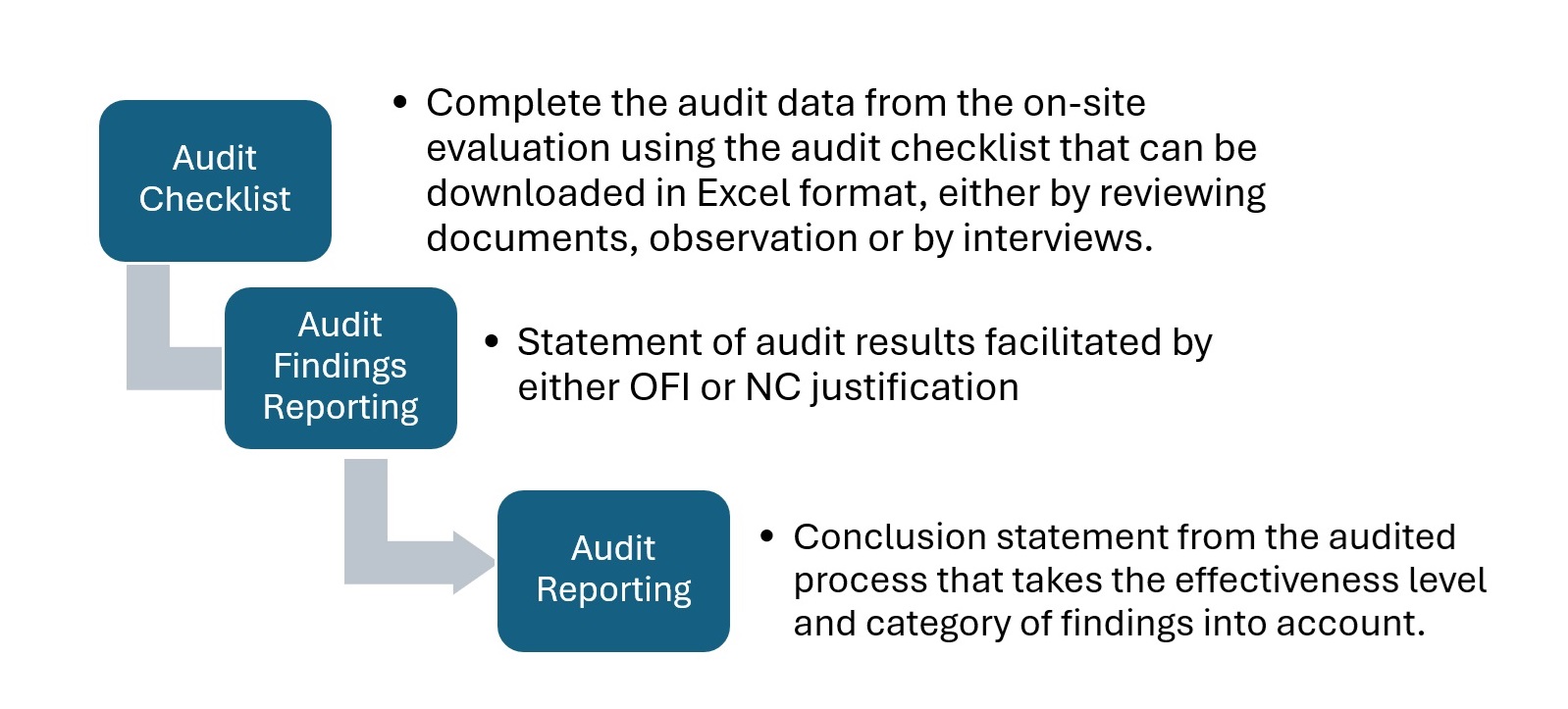
Generate an Audit Report to address the conformity status of the audited process. Based on the evaluation, raise your team's findings—either non-conformity or an OFI statement, depending on the nature of the findings. If no findings need to be classified, neither an NC nor an OFI statement, the conformity shall be supported through a written statement.
Task 2
a) Smallholder: 40.46 ha and below
b) Small estate: above 40.46 ha to 500 ha
c) Large estate/plantations: above 500 ha
In its most extreme forms, child labour involves children being enslaved, separated from their families, exposed to serious hazards and illnesses and/or left to fend for themselves on the streets of large cities – often at a very early age. Whether or not particular forms of “work” can be called “child labour” depends on the child’s age, the type and hours of work performed, the conditions under which it is performed and the objectives pursued by individual countries. The answer varies from country to country, as well as among sectors within countries.
a) Depriving them of the opportunity to attend school
b) Obliging them to leave school prematurely
c) Requiring them to attempt to combine school attendance with excessively long and heavy work
a) Abuse of vulnerability
b) Deception
c) Restriction of movement
d) Isolation
e) Physical and sexual violence
f) Intimidation and threats
g) Retention of identity documents
h) Withholding of wages
i) Debt bondage
j) Abusive working and living conditions
k) Excessive overtime
NOTE. and .
a) Personal liberty (Article 5);
b) Prohibition against slavery and forced labour (Article 6);
c) Protection against retrospective criminal laws and repeated trials (Article 7);
d) Equality before the law and the rights to equal protection of the law (Article 8);
e) Prohibition of banishment and freedom of movement (Article 9);
f) Freedom of speech, assembly and association (Article 10);
g) Freedom of religion (Article 11);
h) Rights in respect of education (Article 12); and
i) Right to property (Article 13)
NOTE. Part II of the Federal Constitution – Fundamental Liberties
a) Article 22 pertaining to the right to social security;
b) Article 23 pertaining to the right to work, the right to equal pay, the right to just and favourable remuneration and the right to form and to join trade unions;
c) Article 24 pertaining to the right to rest and leisure, including limitation of working hours and periodic holidays with pay;
d) Article 25 pertaining to the right to a standard of living adequate for the health and well-being of the worker and his family, the right to security in the event of unemployment, sickness, disability, widowhood or old age, special care and assistance to motherhood and childhood.
a) primary forests that have not been subjected to major human impacts in recent history;
b) regenerated (second-growth) forests that were subjected to major impacts in the past (for instance by agriculture, livestock raising, tree plantations, or intensive logging) but where the main causes of impact have ceased or greatly diminished and the ecosystem has attained much of the species composition, structure, and ecological function of prior or other contemporary natural ecosystems;
c)
ecological function exist in the presence of activities such as:
i) harvesting of timber or other forest products, including management to promote high-value species; and
ii) low intensity, small-scale cultivation within the forest, such as less-intensive forms of swidden agriculture in a forest mosaic.
d) forests that have been partially degraded by anthropogenic or natural causes (e.g. harvesting, fire, climate change, or invasive species) but where the land has not been converted to another use and where degradation does not result in the sustained reduction of tree cover below the thresholds that define a forest or sustained loss of other main elements of ecosystem composition, structure, and ecological function.
The categories "natural forest" and "tree plantation" are mutually exclusive through in some cases the distinction may be nuanced, please see the Operational Guidance on Applying the
Definitions Related to Deforestation, Conversion, and Protection of Ecosystems for further discussion of boundary cases
for the purpose of corporate no-deforestation commitments, the focus is on preventing the conversion of natural forests
i) conversion to agriculture or other non-forest land use;
ii) conversion to a tree plantation; or
iii) severe and sustained degradation
a) Lower bank: Constantly subjected to erosive water current. The plants here are able to survive submerged underwater for extended periods of time, with root systems that are able to hold the soil in place.
b) Upper bank: Occasionally subjected to erosive water current. The plants here are tolerant to sporadic inundation
c) Terrace face: Only subjected to inundation during high flow events, such as annual flooding. The plants here range from wetland to dryland species.
d) Upper terrace: Only subjected to extreme high flow events, such as 1 in 100-year floods. The plants here are mainly dryland species.
NOTE. by The Ministry of Energy and Natural Resources (MNRE) on the Riparian Guideline dated 27th October 2009
4.4.1 Criterion 1: Social Impact Assessment (SIA)
- Independent Smallholders
- Organised Smallholders
- Oil Palm Plantations
- Oil Palm Plantations
- Palm Oil Mill
- Palm Oil Processing Facilities
- Dealers
4.4.2 Criterion 2: safety and health
- Independent Smallholders
- Organised Smallholders
- Oil Palm Plantations
- Oil Palm Plantations
- Palm Oil Mill
- Palm Oil Processing Facilities
- Dealers
4.4.3 Criterion 3: Employment conditions
- Independent Smallholders
- Organised Smallholders
- Oil Palm Plantations
- Oil Palm Plantations
- Palm Oil Mill
- Palm Oil Processing Facilities
- Dealers
4.4.4 Criterion 4: Living conditions
- Independent Smallholders
- Organised Smallholders
- Oil Palm Plantations
- Oil Palm Plantations
- Palm Oil Mill
- Palm Oil Processing Facilities
- Dealers
.
4.5 Principle 5: Environment, natural resources, biodiversity and ecosystem services
Organisation's commitment to environmental management, conservation and protection shall cover prevention of pollution, optimising use of natural resources and mitigating the impacts of global warming Link to P&C on specific PARTs4.5.1 Criterion 1: Environmental management
- Independent Smallholders
- Organised Smallholders
- Oil Palm Plantations
- Oil Palm Plantations
- Palm Oil Mill
- Palm Oil Processing Facilities
- Dealers
4.5.2 Criterion 2: Efficiency of energy use and use of renewable energy
- Independent Smallholders
- Organised Smallholders
- Oil Palm Plantations
- Oil Palm Plantations
- Palm Oil Mill
- Palm Oil Processing Facilities
- Dealers
4.5.3 Criterion 3: Waste management and disposal
- Independent Smallholders
- Organised Smallholders
- Oil Palm Plantations
- Oil Palm Plantations
- Palm Oil Mill
- Palm Oil Processing Facilities
- Dealers
4.5.4 Criterion 4: GHG emissions
- Independent Smallholders
- Organised Smallholders
- Oil Palm Plantations
- Oil Palm Plantations
- Palm Oil Mill
- Palm Oil Processing Facilities
- Dealers
4.5.5 Criterion 5: Water Resources
- Independent Smallholders
- Organised Smallholders
- Oil Palm Plantations
- Oil Palm Plantations
- Palm Oil Mill
- Palm Oil Processing Facilities
- Dealers
4.5.6 Criterion 6: Environmental conservation and protection
- Independent Smallholders
- Organised Smallholders
- Oil Palm Plantations
- Oil Palm Plantations
- Palm Oil Mill
- Palm Oil Processing Facilities
- Dealers
4.5.7 Criterion 7: Zero burning practices
- Independent Smallholders
- Organised Smallholders
- Oil Palm Plantations
- Oil Palm Plantations
- Palm Oil Mill
- Palm Oil Processing Facilities
- Dealers
.
.
.
.
.
.
.
.
.
.
.
.
.
.
.
.
.
.
This Training Material is Belong to OSHISIS Solution PLT
Principles and Criteria
Malaysian Sustainable Palm Oil (MSPO)
Part 3-1: General principles for oil palm plantations
(40.46 hectares to 500 hectares)
(First revision)
1 SCOPE
This Malaysian Standard specifies the requirements for Malaysian Sustainable Palm Oil (MSPO) that organisations will use to demonstrate their commitment to sustainable practices. This Malaysian Standard covers the areas of operations of oil palm cultivation and transportation of products to collecting centres/mills. It applies to all aspects affecting oil palm production which can be monitored and influenced by organisations. It can be applied with reference to the MPOB Codes of Practice and any other management systems implemented by the organisations.2 NORMATIVE REFERENCES
There are no normative references in this document.3 TERMS AND DEFINITIONS
Refer to for the terms and definitions.4 PRINCIPLES AND CRITERIA
.
4.1 Principle 1: Management commitment and responsibility
4.1.1 Criterion 1: Malaysian Sustainable Palm Oil (MSPO) policy
- There shall be a policy on the implementation of Malaysian Sustainable Palm Oil (MSPO) by the organisation to demonstrate its commitment. The policy shall emphasise commitment to continual improvement.
- 4.1.1.1 Indicator 1: A policy for the implementation of MSPO, emphasising commitment to continual improvement, shall be established, communicated and implemented.
- 4.1.1.2 Indicator 2: The continual improvement shall be based on social, environmental impacts, safety and health as well as new information and technology.
4.1.2 Criterion 2: New planting
- New plantings are carried out with consideration of land status and size, current land use, soil type and topography, alignment with authorities’ land use plan, and industry-related government policies.
- Comprehensive HCV, environmental and social impact assessments are undertaken prior to new plantings and a management plan is implemented, and regularly updated during operations.
- New plantings/establishments on peat land, terrain/slopes exceeding 25⁰/300m above sea level, fragile and marginal soils are prohibited unless permitted by the state authorities that have jurisdiction over land matters.
- No new plantings/establishments are carried out on customary land without the owners’ free, prior and informed consent (FPIC)
- 4.1.2.1 Indicator 1: New planting shall be carried out with consideration of the following:
- a) No conversion of natural forest, protected areas and High Conservation Value areas after 31 December 2019;
- b) Updated information on soil types and topography; and
- c) New planting on the following shall be prohibited unless permitted by the state authorities that have jurisdiction over land matters:
- i) steep terrain exceeding 25⁰,;
- ii) areas located 300 m above sea level;
- iii) fragile and marginal soils;
- iv) peat land; and
- v) riparian zones.
- Appropriate and viable conservation measures shall be adopted and implemented to minimise adverse impacts.
- 4.1.2.2 Indicator 2: An Environmental Impact Assessment (EIA) shall be conducted prior to establishing new plantings in accordance with . The results of the EIA shall be incorporated into a management plan(s) and/or operational procedures. The management plan shall be implemented, and reviewed at periodic intervals.
- 4.1.2.3 Indicator 3: A social impact assessment (SIA) shall be conducted prior to establishing new plantings in accordance with established by the scheme owner. The results of the SIA shall be incorporated into a (s) and/or operational procedures. The management plan shall be implemented, and reviewed at periodic intervals.
- 4.1.2.4 Indicator 4: An HCV assessment for new planting shall be conducted in accordance with the scheme owner's guidelines.
- 4.1.2.5 Indicator 5: No new plantings shall be established on customary land without the owners’ free, prior and informed consent (FPIC), dealt with through a documented system that enables indigenous peoples, local communities and other stakeholders to express their views through their own representative institutions.
4.1.3 Criterion 3: Existing site management
- Standard Operating Procedures (SOP) shall be established for activities determined by the organisation.
- 4.1.3.1 Indicator 1: Standard Operating Procedures shall be appropriately documented, consistently implemented and .
- 4.1.3.2 Indicator 2: Where oil palm is cultivated on slopes exceeding 25⁰, the organisation shall implement measures to prevent the following:
- a) erosion and sedimentation; and
- b) contamination of surface and groundwater from soil, nutrient or chemicals.
- 4.1.3.3 Indicator 3: Existing plantings on peat land shall be managed according to any recognised guidelines by the industry.
- 4.1.3.4 Indicator 4: A visual identification or reference system shall be established for each field or block.
- 4.1.3.5 Indicator 5: Where possible, the use of chemicals shall be reduced and environmentally beneficial biological agents are used to control pests and weeds, and help promote pollination and soil health.
4.1.4 Criterion 4: Replanting
- Replanting shall comply with all legal requirements and are in line with industry best practices. Where applicable, the replanting programme shall be established and reviewed annually. Review of SIA, EIA and HCV assessments shall be conducted prior to any activities on site.
- 4.1.4.1 Indicator 1: Replanting programme shall be established in line with industry best practices.
- 4.1.4.2 Indicator 2: SIA, EIA and HCV assessments shall be conducted or relevant management and monitoring plans shall be reviewed prior to any replanting activities. The results of the review shall be incorporated into the replanting programme.
- 4.1.4.3 Indicator 3: Replanting on peat land shall be managed according to any recognised guidelines by the industry.
4.1.5 Criterion 5: Training and competency
- All employees, contractors, and/or smallholders shall be appropriately trained.
- 4.1.5.1 Indicator 1: All employees, contractors and/or smallholders are appropriately trained based on training needs analysis.
- 4.1.5.2 Indicator 2: A training programme (appropriate to the scale of the organisation) and documentation, including of training, shall be maintained. Evaluations of the effectiveness of training shall be conducted.
- 4.1.5.3 Indicator 3: Where contractors are engaged, they shall conform with MSPO requirements and provide required and information in line with tasks contracted to them.
4.1.6 Criterion 6: Economic and financial viability plan
- A documented business or management plan shall be established to demonstrate attention to economic and financial viability.
- 4.1.6.1 Indicator 1: A documented business or shall be established, implemented and reviewed at periodic intervals appropriate to the scale and nature of the organisation.
- 4.1.6.2 Indicator 2: The business or management plan shall include:
- a) A requirement to source planting material from a MPOB-licensed nursery or licensed seed producer;
- b) Crop projection: site yield potential, age profile, FFB yield trends;
- c) Cost of production: cost per tonne of FFB;
- d) Price forecast; and
- e) Financial indicators: cost benefit, discounted cash flow, and return on investment.
- 4.1.6.3 Indicator 3: Prior to the actual commencement of replanting activities, a long-term replanting programme shall be prepared, reviewed annually and made available.
4.1.7 Criterion 7: Commitment to contribute to local sustainable development
- Documentation on commitment to contribute to local sustainable development are available and reviewed.
- 4.1.7.1 Indicator 1: The organisation shall contribute to local sustainable development in consultation with indigenous people and local communities through appropriate programmes.
4.1.8 Criterion 8: Complaints and grievances handling
- A mechanism shall be established to handle and document complaints and grievances.
- 4.1.8.1 Indicator 1: A system or procedure for dealing with complaints and grievances shall be established, documented and communicated to employees and stakeholders. The mechanism shall ensure no reprisal and/or discrimination against complainants and maintain confidentiality and anonymity when requested or necessary.
- 4.1.8.2 Indicator 2: The system shall be able to resolve disputes in an effective, timely and appropriate manner, and is accepted by all parties.
- 4.1.8.3 Indicator 3: Complaints and resolutions for the last 24 months shall be and made available to affected stakeholders upon request.
4.1.9 Criterion 9: Internal audit
- An internal audit shall be planned and conducted annually to ensure conformance to MSPO requirements.
- 4.1.9.1 Indicator 1: Procedures for planning, conducting and of audits as well as follow-ups shall be established.
- 4.1.9.2 Indicator 2: Root cause analysis for each nonconformity raised shall be carried out to determine the appropriate corrective action.
4.1.10 Criterion 10: Management review
- Management shall annually review its MSPO implementation to ensure its continuing suitability, adequacy and effectiveness.
- 4.1.10.1 Indicator 1: The organisation shall review its MSPO implementation annually covering the following:
- a) The status of actions from the previous management reviews;
- b) Changes in:
- i) External and internal issues that are relevant to the MSPO system; and
- ii) The needs and expectations of interested parties (stakeholders), including compliance obligations.
- c) The extent to which MSPO have been achieved;
- d) Information on the organisation’s performance including trends in:
- i) Nonconformities and corrective actions;
- ii) results;
- iii) Fulfilment of its compliance obligations; and
- iv) Audit results.
- e) Adequacy of resources;
- f) Relevant communication(s) from stakeholders including complaints: and
- g) Opportunities for continual improvement.
.
4.2 Principle 2: Transparency
4.2.1 Criterion 1: Communication and consultation
- A system or procedure(s) for transparent communication and consultation with stakeholders shall be established and documented.
- When establishing its communication system, the organisation shall take into account its compliance obligations, types of information to be shared and its consistency with information generated by its MSPO implementation as well as reliability.
- The organisation shall respond to relevant communication from its stakeholders.
- 4.2.1.1 Indicator 1: Communication and consultation procedures shall be established and communicated to relevant stakeholders.
- 4.2.1.2 Indicator 2: Stakeholders shall be identified. A list of stakeholders and of all consultations, communications and actions taken in response to input from stakeholders, shall be maintained.
- 4.2.1.3 Indicator 3: A management official shall be nominated to be responsible for communications and consultation.
- 4.2.1.4 Indicator 4: The organisation shall provide information requested by relevant stakeholders and management documents shall be publicly available, except those limited by commercial confidentiality or disclosure that could result in negative environmental or social outcomes. Information and documents shall be in appropriate languages and forms.
4.2.2 Criterion 2: Traceability
- A system or procedure(s) for traceability along the supply chain shall be established and documented whereby traceability starts at the plantation and/or smallholding.
- 4.2.2.1 Indicator 1: The organisation shall establish, implement and maintain a Standard Operating Procedure to comply with the requirements for traceability of the relevant product(s).
- 4.2.2.2 Indicator 2: of sales, delivery or transportation of products shall be maintained.
- Information and records shall include at least the following information:
- a) Name and address of the buyer;
- b) Product(s) identification;
- c) Quantity of products delivered;
- d) Loading or delivery date;
- e) Related transportation documentation with a unique identification number;
- f) MSPO certificate number; and
- g) MSPO certificate validity.
- 4.2.2.3 Indicator 3: The organisation shall assign relevant employee(s) to implement and maintain traceability requirements.
4.2.3 Criterion 3: Transparent and fair price dealing
- Mechanisms for fair/mutually agreed pricing of products and other services shall be documented and effectively implemented.
- 4.2.3.1 Indicator 1: Pricing for products and other services shall be and effectively implemented.
- 4.2.3.2 Indicator 2: All contracts shall be mutually agreed, legal and transparent, and agreed payments shall be made in a timely manner. The contracts shall include acceptance of approved auditors to verify fulfilment of MSPO requirements. A physical on-site inspection may be conducted, if required.
4.2.4 Criterion 4: Ethical conduct
- The organisation shall subscribe to ethical conduct and anti-bribery in their business relations with employees, communities and stakeholders.
- 4.2.4.1 Indicator 1: A policy for ethical conduct and anti-bribery shall be established, communicated and implemented in all business operations and transactions, including recruitment and award of contracts.
- 4.2.4.2 Indicator 2: A system is in place to conformance and the implementation of the policy and overall ethical business and anti-bribery practice.
.
4.3 Principle 3: Compliance with legal and other requirements
4.3.1 Criterion 1: Regulatory requirements
- The organisation shall comply with local, national and ratified international laws, conventions, and regulations.
- 4.3.1.1 Indicator 1: The organisation shall identify applicable related to their operations. Changes shall be updated.
- 4.3.1.2 Indicator 2: Compliance with identified legal requirements, including local, state, national and ratified international laws, conventions, and regulations, shall be .
4.3.2 Criterion 2: Rights to use land
- Oil palm cultivation shall not diminish the rights of other users.
- 4.3.2.1 Indicator 1: The organisation shall ensure that oil palm cultivation activities do not diminish the rights of others to land.
- 4.3.2.2 Indicator 2: Proof of ownership or rights to use land such as land title, lease or joint venture agreement with indigenous peoples and history of land tenure (if available) shall be made available to relevant stakeholders upon request.
- 4.3.2.3 Indicator 3: Where there are, or have been, disputes, proof of legal acquisition of land title and fair that have been or are being made to previous owners and occupants shall have been accepted and agreed upon with FPIC and shall be made available to relevant stakeholders.
- 4.3.2.4 Indicator 4: Legal perimeter boundary markers shall be clearly demarcated and visibly maintained on the ground where practicable.
4.3.3 Criterion 3: Native customary rights
- Customary rights shall not be threatened or reduced. Any conflict or land disputes shall be resolved in accordance with an FPIC process.
- 4.3.3.1 Indicator 1: Where lands are subjected to customary rights, the organisation shall demonstrate that these rights are understood and are not being threatened or reduced.
- 4.3.3.2 Indicator 2: of an appropriate scale and showing the extent of native customary rights shall be developed through a participatory process and shall be made available to affected rights holders and relevant stakeholders.
- 4.3.3.3 Indicator 3: Negotiations and FPIC implementation shall be and copies of negotiated agreements made available to affected rights holders and relevant stakeholders upon request.
.
4.4 Principle 4: Responsibility to social, health, safety and employment conditions
4.4.1 Criterion 1: Social Impact Assessment (SIA)
- Social impact assessments shall be conducted with the participation of stakeholders.
- 4.4.1.1 Indicator 1: A social impact assessment shall be conducted with the participation of relevant stakeholders in accordance with provided by the scheme owner to mitigate negative impacts and promote positive impacts. Food security and shall be incorporated as aspects to be assessed, if applicable.
- 4.4.1.2 Indicator 2: The results of the assessment shall be incorporated into an appropriate and/or operational procedures and reviewed at periodic intervals.
- 4.4.1.3 Indicator 3: The SIA conducted shall be reviewed prior to replanting activities or at five-year intervals.
4.4.2 Criterion 2: safety and health
- Organisational activities shall be assessed and plans shall be established to achieve zero occupational safety and health accidents, in compliance with relevant legal requirements. Employers shall provide occupational safety and health education and information to achieve the objective of zero occupational safety and health accidents for all employees including young persons, pregnant and breastfeeding female workers.
- 4.4.2.1 Indicator 1: An occupational safety and health policy and plan shall be established, communicated and implemented.
- 4.4.2.2 Indicator 2: The occupational safety and health shall cover the following:
- a) Person(s) responsible for workers' health and safety;
- b) at the workplace using Hierarchy of Control;
- c) Standard Operating Procedures (SOPs) based on the Hazard Identification and Risk Assessment;
- d) Training programme based on the Hazard Identification and Risk Assessment;
- e) Two-way communication with employees where issues such as health, safety and wellbeing are discussed openly including concerns of employees and any remedial actions taken;
- f) Emergency preparedness and response; and
- g) First-Aid system in workplace.
- 4.4.2.3 Indicator 3: Occupational safety and health shall be maintained.
4.4.3 Criterion 3: Employment conditions
- There shall be a policy on respecting human rights to demonstrate the organisation’s commitment. In line with this policy, the organisation shall ensure that:
- a) Employment conditions comply with and the ILO Decent Work Agenda;
- b) No forms of forced or trafficked labour as well as child labour are used;
- c) Any form of discrimination and harassment is prohibited; and
- d) Triangular employment arrangements are practised in line with (a).
- The organisation shall also ensure there is no retaliation against human rights defenders and whistle blowers.
- Social benefits shall be provided to employees and their families.
- 4.4.3.1 Indicator 1: A policy on respecting human rights shall be established, communicated to relevant stakeholders and implemented. The policy shall be in line with the Federal Constitution, the UN Declaration on Human Rights and the ILO Decent Work Agenda.
- 4.4.3.2 Indicator 2: There shall be no forms of forced or trafficked labour whereby all work is voluntary and the following are prohibited:
- a) Abuse of vulnerability;
- b) Deception;
- c) Lack of freedom of workers to resign and restriction of movement;
- d) Isolation;
- e) Physical and sexual violence;
- f) Retention of identity documents or passports except during the renewal process and/or legal administration purpose with the consignment letter agreed by both parties;
- g) Withholding of wages;
- h) Debt bondage;
- i) Abusive working and living conditions;
- j) Payment of statutory recruitment fees by workers;
- k) Involuntary or excessive overtime;
- l) Contract substitution; and
- m) Penalty for termination of employment.
- 4.4.3.3 Indicator 3: There shall be no evidence the organisation engages in or supports discriminatory practices. The organisation shall provide equal opportunity and treatment regardless of age, race, colour, gender, religion, political opinion, nationality, social origin or any other distinguishing characteristics. Disabled persons shall be considered for tasks suitable to their abilities.
- 4.4.3.4 Indicator 4: There shall be no evidence of harassment, violence, physical or verbal abuse or any forms of intimidation, including retaliation against human rights defenders and whistle blowers. The organisation shall provide guidelines for implementation and maintain of all disciplinary actions taken, and the reason for the disciplinary action.
- 4.4.3.5 Indicator 5: The organisation shall ensure that employees’ (including employees of contractors) pay and conditions, working hours and breaks of each employee, wages and overtime payments on pay slips shall comply with and where applicable, Collective Agreements.
- 4.4.3.6 Indicator 6: A transparent system for recording working hours, paid leave and overtime shall be implemented in accordance with legal requirements and/or provisions in the Collective Agreements. Overtime shall be mutually agreed, compensated at applicable rates and .
- 4.4.3.7 Indicator 7: The organisation shall maintain an accurate labour register (in accordance with relevant laws). shall contain information such as full name, gender, date of birth, date of entry, job description, wage and period of employment as well as details, where applicable.
- 4.4.3.8 Indicator 8: All employees, including contractors' employees, shall be provided with fair contracts that have been agreed by both employee and principal employer in accordance with . The contract shall be made available in a language the worker understands and copies of shall be available to employees.
- 4.4.3.9 Indicator 9: Other forms of social benefits shall be offered by the employer to employees and their immediate families such as incentives for good work performance, bonus payment, professional development, medical care and health provisions. Provision of such incentives and social benefits that are provided shall meet Collective Agreements, where applicable.
- 4.4.3.10 Indicator 10: Children shall not be employed or exploited. Work by young persons is acceptable under adult supervision, and when not interfering with their education. They shall not be exposed to hazardous working conditions according to .
- 4.4.3.11 Indicator 11: The organisation shall respect the right of all employees to form or join trade unions and allow workers own representative(s) to facilitate collective bargaining in accordance with applicable laws and regulations. Employees shall have the right to organise and negotiate their work conditions. Employees exercising this right shall not be discriminated against or suffer repercussions.
- 4.4.3.12 Indicator 12: The organisation shall fulfil all indicators of Criterion 3 in ensuring that there is no mistreatment of workers in the case of triangular employment relationship. The final responsibilities/accountabilities lie with the principal employer.
4.4.4 Criterion 4: Living conditions
- Where housing is provided, decent living conditions, including clean water for domestic use, are provided to employees and their families.
- 4.4.4.1 Indicator 1: Where housing is provided, in accordance with applicable shall be adhered to.
- 4.4.4.2 Indicator 2: for domestic use from own water processing facility shall be done at least once a year.
.
4.5 Principle 5: Environment, natural resources, biodiversity and ecosystem services
4.5.1 Criterion 1: Environmental management
- Organisational activities shall be assessed and plans shall be established to mitigate adverse environmental impacts and promote beneficial impacts.
- 4.5.1.1 Indicator 1: An environmental policy shall be established, communicated and implemented.
- 4.5.1.2 Indicator 2: The organisation shall assess and all polluting activities that could result in environmental impacts.
- 4.5.1.3 Indicator 3: The organisation shall establish, implement and review in line with to mitigate adverse environmental impacts and promote beneficial impacts.
- 4.5.1.4 Indicator 4: The organisation shall establish and implement a training programme according to training needs analysis to ensure all employees understand the policy and plans.
4.5.2 Criterion 2: Efficiency of energy use and use of renewable energy
- Energy use, including renewable energy shall be optimised and monitored where applicable.
- 4.5.2.1 Indicator 1: The organisation shall assess, optimise (whenever practical) and monitor its energy consumption, including fuel usage by contractors (FFB evacuation/transport), at periodic intervals.
- 4.5.2.2 Indicator 2: The use of renewable energy shall be encouraged and applied where practical.
4.5.3 Criterion 3: Waste management and disposal
- All waste products and sources of pollution shall be identified and documented, and a waste management plan shall be established and implemented. There shall be no use of fire for waste disposal except in situations allowed under the legal framework.
- 4.5.3.1 Indicator 1: A to prevent and minimise pollution shall be established and implemented. The waste management plan shall include measures for (but not limited to):
- a) Identifying and monitoring sources of waste and pollution; and
- b) Improving the efficiency of resources utilisation and recycling of potential wastes and/or converting them into value-added by-products, where applicable.
- 4.5.3.2 Indicator 2: The organisation shall establish Standard Operating Procedures for handling empty pesticide containers, used and/or expired chemicals that are in accordance with
- 4.5.3.3 Indicator 3: The organisation shall ensure that all domestic wastes are disposed of appropriately.
4.5.4 Criterion 4: GHG emissions
- In contributing to the national commitment for climate change, all actors along the value chain shall identify the sources of GHG emissions, monitors, and plans for reductions, whenever applicable. Reporting on this criterion shall be done on an annual basis.
- 4.5.4.1 Indicator 1: The organisation shall identify GHG emissions and saving sources from:
- a) Land use change, after 31 December 2019;
- b) Use of fertiliser;
- c) Transportation of fertiliser/agricultural input and FFB;
- d) Use of energy; and
- e) Crop sequestration and conservation area, if available.
- 4.5.4.2 Indicator 2: Monitoring of GHG emissions shall use the GHG calculator from the scheme owner and plans for reduction shall be established and implemented.
- 4.5.4.3 Indicator 3: The organisation shall report the following to the scheme owner on an annual basis:
- a) Source of emission;
- b) Amount of emission;
- c) Energy usage and production volume; and
- d) Year-on-year GHG .
4.5.5 Criterion 5: Water Resources
- The organisation shall establish a water management plan to prevent pollution and maintain the quality and availability of water resources.
- 4.5.5.1 Indicator 1: The organisation shall establish and implement a to maintain the quality and availability of water resources (surface and ground water). The water management plan should include:
- a) Assessment of water usage, sources of supply and its quality;
- b) Monitoring of outgoing water, which may have negative impacts into the natural waterways;
- c) Ways to optimise water and nutrient usage to reduce wastage, including rainwater harvesting practices;
- d) Protection of water courses and wetlands, including maintaining, rehabilitating and/or enhance riparian/riparian buffer zones before, during and after replanting;
- e) Where bore wells are being used for water supply, the level of the ground water table should be measured at least annually; and
- f) Ways to monitor and ensure adequate and quality water for sustaining livelihood, human well-being and socio-economic development, where applicable.
- 4.5.5.2 Indicator 2: No construction of bunds, weirs and dams, which control or divert the flow of water, across main rivers or waterways passing through an estate.
4.5.6 Criterion 6: Environmental conservation and protection
- Information shall be collected within or adjacent to the management area and appropriate measures are taken for the protection of the species or habitat following the HCV approach and relevant local
- 4.5.6.1 Indicator 1: The organisation, through engagement with stakeholders, shall assess, identify and the presence and status of High Conservation Values that exist within or adjacent to the management area. The results of the assessment shall be incorporated into a .
- 4.5.6.2 Indicator 2: If High Conservation Values, rare, threatened or endangered species are present, a shall be established, effectively implemented and include:
- a) Ensuring any relating to the protection of the species are met;
- b) Discouraging any illegal or inappropriate hunting, fishing or collecting activities;
- c) Developing responsible measures to resolve human-wildlife conflicts;
- d) Putting in place measures such as enrichment of riparian areas, unplantable areas and other set-asides, to help sustain wild populations of rare, threatened or endangered species; and
- e) Protection of customary sites as well as allowing access to indigenous people and local communities.
- 4.5.6.3 Indicator 3: The organisation shall demonstrate that periodic monitoring is carried out to assess changes in the status of High Conservation Values, and shall adapt its at periodic intervals to ensure their effective protection.
4.5.7 Criterion 7: Zero burning practices
- There shall be no open burning, except in situations allowed under the legal framework. Response and mitigation plans shall be established to prevent fire.
- 4.5.7.1 Indicator 1: There shall be no use of fire for preparing land for oil palm cultivation and replanting. Previous crops that are felled should be mowed down, chipped and shredded, windrowed or pulverised or ploughed and mulched or use for other commercial purposes.
- 4.5.7.2 Indicator 2: Special approval for use of fire from relevant authorities shall be sought in areas where no other effective measures exist, previous crops are highly diseased, and there is a significant risk of disease spreading to the next crop. In such cases, the use of fire shall be carried out as prescribed by the relevant laws and guidelines.
- 4.5.7.3 Indicator 3: The organisation shall prevent fire occurrence within and adjacent to the management area. A response and shall be established as part of the commitment to prevent fire.
This Training Material is Belong to OSHISIS Solution PLT
Principles and Criteria
Malaysian Sustainable Palm Oil (MSPO)
3-2: General principles for oil palm plantations
(More than 500 hectares)
1 SCOPE
This Malaysian Standard specifies the requirements for Malaysian Sustainable Palm Oil (MSPO) that organisations will use to demonstrate their commitment to sustainable practices. This Malaysian Standard covers the areas of operations of oil palm cultivation and transportation of products to collecting centres/mills. It applies to all aspects affecting oil palm production which can be monitored and influenced by organisations. It can be applied with reference to the MPOB Codes of Practice and any other management systems implemented by the organisations.2 NORMATIVE REFERENCES
There are no normative references in this document.3 TERMS AND DEFINITIONS
Refer to for the terms and definitions.4 PRINCIPLES AND CRITERIA
.
4.1 Principle 1: Management commitment and responsibility
4.1.1 Criterion 1: Malaysian Sustainable Palm Oil (MSPO) policy
- There shall be a policy on the implementation of Malaysian Sustainable Palm Oil (MSPO) by the organisation to demonstrate its commitment. The policy shall emphasise commitment to continual improvement.
- 4.1.1.1 Indicator 1: A policy for the implementation of MSPO, emphasising commitment to continual improvement, shall be established, communicated and implemented.
- 4.1.1.2 Indicator 2: The continual improvement shall be based on social, environmental impacts, safety and health as well as new information and technology.
4.1.2 Criterion 2: New planting
- New plantings are carried out with consideration of land status and size, current land use, soil type and topography, alignment with authorities’ land use plan, and industry-related government policies.
- Comprehensive HCV, environmental and social impact assessments are undertaken prior to new plantings and a management plan is implemented, monitored and regularly updated during operations.
- New plantings/establishments on peat land, terrain/slopes exceeding 25⁰/300m above sea level, fragile and marginal soils are prohibited unless permitted by the state authorities that have jurisdiction over land matters.
- No new plantings/establishments are carried out on customary land without the owners’ free, prior and informed consent (FPIC)
- 4.1.2.1 Indicator 1: New planting shall be carried out with consideration of the following:
- a) No conversion of natural forest, protected areas and High Conservation Values areas after 31 December 2019;
- b) Updated information on soil types and topography; and
- c) New planting on the following shall be prohibited unless permitted by the state authorities that have jurisdiction over land matters:
- i) steep terrain exceeding 25⁰,;
- ii) areas located 300 m above sea level;
- iii) fragile and marginal soils;
- iv) peat land; and
- v) riparian zones.
- Appropriate and viable conservation measures shall be adopted and implemented to minimise adverse impacts.
- 4.1.2.2 Indicator 2: An Environmental Impact Assessment (EIA) shall be conducted prior to establishing new plantings in accordance with . The results of the EIA shall be incorporated into a and/or operational procedures. The management plan shall be implemented, and reviewed at periodic intervals.
- 4.1.2.3 Indicator 3: A social impact assessment (SIA) shall be conducted prior to establishing new plantings in accordance with established by the scheme owner. The results of the SIA shall be incorporated into a and/or operational procedures. The management plan shall be implemented, and reviewed at periodic intervals.
- 4.1.2.4 Indicator 4: An HCV assessment for new planting shall be conducted in accordance with the scheme owner's guidelines.
- 4.1.2.5 Indicator 5: No new plantings shall be established on customary land without the owners’ free, prior and informed consent (FPIC), dealt with through a documented system that enables indigenous peoples, local communities and other stakeholders to express their views through their own representative institutions.
4.1.3 Criterion 3: Existing site management
- Standard Operating Procedures (SOP) shall be established for activities determined by the organisation.
- 4.1.3.1 Indicator 1: Standard Operating Procedures shall be appropriately documented, consistently implemented and .
- 4.1.3.2 Indicator 2: Where oil palm is cultivated on slopes exceeding 25⁰, the organisation shall implement measures to prevent the following:
- a) erosion and sedimentation; and
- b) contamination of surface and groundwater from soil, nutrient or chemicals.
- 4.1.3.3 Indicator 3: Existing plantings on peat land shall be managed according to any recognised guidelines by the industry.
- 4.1.3.4 Indicator 4: A visual identification or reference system shall be established for each field or block.
- 4.1.3.5 Indicator 5: Where possible, the use of chemicals shall be reduced and environmentally beneficial biological agents are used to control pests and weeds, and help promote pollination and soil health.
4.1.4 Criterion 4: Replanting
- Replanting shall comply with all legal requirements and are in line with industry best practices. Where applicable, the replanting programme shall be established and reviewed annually. Review of SIA, EIA and HCV assessments shall be conducted prior to any activities on site.
- 4.1.4.1 Indicator 1: Replanting programme shall be established in line with industry best practices.
- 4.1.4.2 Indicator 2: SIA, EIA and HCV assessments shall be conducted or relevant management and monitoring plans shall be reviewed prior to any replanting activities. The results of the review shall be incorporated into the replanting programme.
- 4.1.4.3 Indicator 3: Replanting on peat land shall be managed according to any recognised guidelines by the industry.
4.1.5 Criterion 5: Training and competency
- All employees, contractors, and/or smallholders shall be appropriately trained.
- 4.1.5.1 Indicator 1: All employees, contractors and/or smallholders are appropriately trained based on training needs analysis.
- 4.1.5.2 Indicator 2: A training programme (appropriate to the scale of the organisation) and documentation, including of training, shall be maintained. Evaluations of the effectiveness of training shall be conducted.
- 4.1.5.3 Indicator 3: Where contractors are engaged, they shall conform with MSPO requirements and provide required
4.1.6 Criterion 6: Economic and financial viability plan
- A documented business or management plan shall be established to demonstrate attention to economic and financial viability.
- 4.1.6.1 Indicator 1: A business or shall be established, implemented and reviewed at periodic intervals appropriate to the scale and nature of the organisation.
- 4.1.6.2 Indicator 2: The business or management plan shall include:
- a) A requirement to source planting material from a MPOB-licensed nursery or licensed seed producer;
- b) Crop projection: site yield potential, age profile, FFB yield trends;
- c) Cost of production: cost per tonne of FFB;
- d) Price forecast; and
- e) Financial indicators: cost benefit, discounted cash flow, and return on investment.
- 4.1.6.3 Indicator 3: Prior to the actual commencement of replanting activities, a long-term replanting programme shall be prepared, reviewed annually and made available.
4.1.7 Criterion 7: Commitment to contribute to local sustainable development
- Documentation on commitment to contribute to local sustainable development are available and reviewed.
- 4.1.7.1 Indicator 1: The organisation shall contribute to local sustainable development in consultation with indigenous people and local communities through appropriate programmes.
4.1.8 Criterion 8: Complaints and grievances handling
- A mechanism shall be established to handle and document complaints and grievances.
- 4.1.8.1 Indicator 1: A system or procedure for dealing with complaints and grievances shall be established, documented and communicated to employees and stakeholders. The mechanism shall ensure no reprisal and/or discrimination against complainants and maintain confidentiality and anonymity when requested or necessary.
- 4.1.8.2 Indicator 2: The system shall be able to resolve disputes in an effective, timely and appropriate manner, and is accepted by all parties.
- 4.1.8.3 Indicator 3: Complaints and resolutions for the last 24 months shall be and made available to affected stakeholders upon request.
4.1.9 Criterion 9: Internal audit
- An internal audit shall be planned and conducted annually to ensure conformance to MSPO requirements.
- 4.1.9.1 Indicator 1: Procedures for planning, conducting and of audits as well as follow-ups shall be established.
- 4.1.9.2 Indicator 2: Root cause analysis for each nonconformity raised shall be carried out to determine the appropriate corrective action.
4.1.10 Criterion 10: Management review
- Management shall annually review its MSPO implementation to ensure its continuing suitability, adequacy and effectiveness.
- 4.1.10.1 Indicator 1: The organisation shall review its MSPO implementation annually covering the following:
- a) The status of actions from the previous management reviews;
- b) Changes in:
- i) External and internal issues that are relevant to the MSPO system; and
- ii) The needs and expectations of interested parties (stakeholders), including compliance obligations.
- c) The extent to which MSPO have been achieved;
- d) Information on the organisation’s performance including trends in:
- i) Nonconformities and corrective actions;
- ii) results;
- iii) Fulfilment of its compliance obligations; and
- iv) Audit results.
- e) Adequacy of resources;
- f) Relevant communication(s) from stakeholders including complaints: and
- g) Opportunities for continual improvement.
.
4.2 Principle 2: Transparency
4.2.1 Criterion 1: Communication and consultation
- A system or procedure(s) for transparent communication and consultation with stakeholders shall be established and documented.
- When establishing its communication system, the organisation shall take into account its compliance obligations, types of information to be shared and its consistency with information generated by its MSPO implementation as well as reliability.
- The organisation shall respond to relevant communication from its stakeholders.
- 4.2.1.1 Indicator 1: Communication and consultation procedures shall be established and communicated to relevant stakeholders.
- 4.2.1.2 Indicator 2: Stakeholders shall be identified. A list of stakeholders and of all consultations, communications and actions taken in response to input from stakeholders, shall be maintained.
- 4.2.1.3 Indicator 3: A management official shall be nominated to be responsible for communications and consultation.
- 4.2.1.4 Indicator 4: The organisation shall provide information requested by relevant stakeholders and management documents shall be publicly available, except those limited by commercial confidentiality or disclosure that could result in negative environmental or social outcomes. Information and documents shall be in appropriate languages and forms.
4.2.2 Criterion 2: Traceability
- A system or procedure(s) for traceability along the supply chain shall be established and documented whereby traceability starts at the plantation and/or smallholding.
- 4.2.2.1 Indicator 1: The organisation shall establish, implement and maintain a Standard Operating Procedure to comply with the requirements for traceability of the relevant product(s).
- 4.2.2.2 Indicator 2: of sales, delivery or transportation of products shall be maintained.
- Information and records shall include at least the following information:
- a) Name and address of the buyer;
- b) Product(s) identification;
- c) Quantity of products delivered;
- d) Loading or delivery date;
- e) Related transportation documentation with a unique identification number;
- f) MSPO certificate number; and
- g) MSPO certificate validity.
- 4.2.2.3 Indicator 3: The organisation shall assign relevant employee(s) to implement and maintain traceability requirements.
4.2.3 Criterion 3: Transparent and fair price dealing
- Mechanisms for fair/mutually agreed pricing of products and other services shall be documented and effectively implemented.
- 4.2.3.1 Indicator 1: Pricing for products and other services shall be and effectively implemented.
- 4.2.3.2 Indicator 2: All contracts shall be mutually agreed, legal and transparent, and agreed payments shall be made in a timely manner. The contracts shall include acceptance of approved auditors to verify fulfilment of MSPO requirements. A physical on-site inspection may be conducted, if required.
4.2.4 Criterion 4: Ethical conduct
- The organisation shall subscribe to ethical conduct and anti-bribery in their business relations with employees, communities and stakeholders.
- 4.2.4.1 Indicator 1: A policy for ethical conduct and anti-bribery shall be established, communicated and implemented in all business operations and transactions, including recruitment and award of contracts.
- 4.2.4.2 Indicator 2: A system is in place to conformance and the implementation of the policy and overall ethical business and anti-bribery practice.
.
4.3 Principle 3: Compliance with legal and other requirements
4.3.1 Criterion 1: Regulatory requirements
- The organisation shall comply with local, national and ratified international laws, conventions, and regulations.
- 4.3.1.1 Indicator 1: The organisation shall identify applicable related to their operations. Changes shall be updated.
- 4.3.1.2 Indicator 2: Compliance with identified legal requirements, including local, state, national and ratified international laws, conventions, and regulations, shall be .
4.3.2 Criterion 2: Rights to use land
- Oil palm cultivation shall not diminish the rights of other users.
- 4.3.2.1 Indicator 1: The organisation shall ensure that oil palm cultivation activities do not diminish the rights of others to land.
- 4.3.2.2 Indicator 2: Proof of ownership or rights to use land such as land title, lease or joint venture agreement with indigenous peoples and history of land tenure (if available) shall be made available to relevant stakeholders upon request.
- 4.3.2.3 Indicator 3: Where there are, or have been, disputes, proof of legal acquisition of land title and fair compensation that have been or are being made to previous owners and occupants shall have been accepted and agreed upon with FPIC and shall be made available to relevant stakeholders.
- 4.3.2.4 Indicator 4: Legal perimeter boundary markers shall be clearly demarcated and visibly maintained on the ground where practicable.
4.3.3 Criterion 3: Native customary rights
- Customary rights shall not be threatened or reduced. Any conflict or land disputes shall be resolved in accordance with an FPIC process.
- 4.3.3.1 Indicator 1: Where lands are subjected to customary rights, the organisation shall demonstrate that these rights are understood and are not being threatened or reduced.
- 4.3.3.2 Indicator 2: of an appropriate scale and showing the extent of native customary rights shall be developed through a participatory process and shall be made available to affected rights holders and relevant stakeholders.
- 4.3.3.3 Indicator 3: Negotiations and FPIC implementation shall be and copies of negotiated made available to affected rights holders and relevant stakeholders upon request.
.
4.4 Principle 4: Responsibility to social, health, safety and employment conditions
4.4.1 Criterion 1: Social Impact Assessment (SIA)
- Social impact assessments shall be conducted with the participation of stakeholders.
- 4.4.1.1 Indicator 1: A social impact assessment shall be conducted with the participation of relevant stakeholders in accordance with provided by the scheme owner to mitigate negative impacts and promote positive impacts. Food security and shall be incorporated as aspects to be assessed, if applicable.
- 4.4.1.2 Indicator 2: The results of the assessment shall be incorporated into an appropriate and/or operational procedures and reviewed at periodic intervals.
- 4.4.1.3 Indicator 3: The SIA conducted shall be reviewed prior to replanting activities or at five-year intervals.
4.4.2 Criterion 2: safety and health
- Organisational activities shall be assessed and plans shall be established to achieve zero occupational safety and health accidents, in compliance with relevant legal requirements. Employers shall provide occupational safety and health education and information to achieve the objective of zero occupational safety and health accidents for all employees including young persons, pregnant and breastfeeding female workers.
- 4.4.2.1 Indicator 1: An occupational safety and health policy and plan shall be established, communicated and implemented.
- 4.4.2.2 Indicator 2: The occupational safety and health shall cover the following:
- a) Person(s) responsible for workers' health and safety;
- b) at the workplace using Hierarchy of Control;
- c) Standard Operating Procedures (SOPs) based on the Hazard Identification and Risk Assessment;
- d) Training programme based on the Hazard Identification and Risk Assessment;
- e) Two-way communication with employees where issues such as health, safety and wellbeing are discussed openly including concerns of employees and any remedial actions taken;
- f) Emergency preparedness and response; and
- g) First-Aid system in workplace.
- 4.4.2.3 Indicator 3: Occupational safety and health shall be maintained.
4.4.3 Criterion 3: Employment conditions
- There shall be a policy on respecting human rights to demonstrate the organisation’s commitment. In line with this policy, the organisation shall ensure that:
- a) Employment conditions comply with and the ILO Decent Work Agenda;
- b) No forms of forced or trafficked labour as well as child labour are used;
- c) Any form of discrimination and harassment is prohibited; and
- d) Triangular employment arrangements are practised in line with (a).
- The organisation shall also ensure there is no retaliation against human rights defenders and whistle blowers.
- Social benefits shall be provided to employees and their families.
- 4.4.3.1 Indicator 1: A policy on respecting human rights shall be established, communicated to relevant stakeholders and implemented. The policy shall be in line with the Federal Constitution, the UN Declaration on Human Rights and the ILO Decent Work Agenda.
- 4.4.3.2 Indicator 2: There shall be no forms of forced or trafficked labour whereby all work is voluntary and the following are prohibited:
- a) Abuse of vulnerability;
- b) Deception;
- c) Lack of freedom of workers to resign and restriction of movement;
- d) Isolation;
- e) Physical and sexual violence;
- f) Retention of identity documents or passports except during the renewal process and/or legal administration purpose with the consignment letter agreed by both parties;
- g) Withholding of wages;
- h) Debt bondage;
- i) Abusive working and living conditions;
- j) Payment of statutory recruitment fees by workers;
- k) Involuntary or excessive overtime;
- l) Contract substitution; and
- m) Penalty for termination of employment.
- 4.4.3.3 Indicator 3: There shall be no evidence the organisation engages in or supports discriminatory practices. The organisation shall provide equal opportunity and treatment regardless of age, race, colour, gender, religion, political opinion, nationality, social origin or any other distinguishing characteristics. Disabled persons shall be considered for tasks suitable to their abilities.
- 4.4.3.4 Indicator 4: There shall be no evidence of harassment, violence, physical or verbal abuse or any forms of intimidation, including retaliation against human rights defenders and whistle blowers. The organisation shall provide guidelines for implementation and maintain of all disciplinary actions taken, and the reason for the disciplinary action.
- 4.4.3.5 Indicator 5: The organisationshall ensure that employees’ (including employees of contractors) pay and conditions, working hours and breaks of each employee, wages and overtime payments on pay slips shall comply with and where applicable, Collective Agreements.
- 4.4.3.6 Indicator 6: A transparent system for recording working hours, paid leave and overtime shall be implemented in accordance with legal requirements and/or provisions in the Collective Agreements. Overtime shall be mutually agreed, compensated at applicable rates and .
- 4.4.3.7 Indicator 7: The organisation shall maintain an accurate labour register (in accordance with relevant laws). shall contain information such as full name, gender, date of birth, date of entry, job description, wage and period of employment as well as details, where applicable.
- 4.4.3.8 Indicator 8: All employees, including contractors' employees, shall be provided with fair contracts that have been agreed by both employee and principal employer in accordance with . The contract shall be made available in a language the worker understands and copies of shall be available to employees.
- 4.4.3.9 Indicator 9: Other forms of social benefits shall be offered by the employer to employees and their immediate families such as incentives for good work performance, bonus payment, professional development, medical care and health provisions. Provision of such incentives and social benefits that are provided shall meet Collective Agreements, where applicable.
- 4.4.3.10 Indicator 10: Children shall not be employed or exploited. Work by young persons is acceptable under adult supervision, and when not interfering with their education. They shall not be exposed to hazardous working conditions according to .
- 4.4.3.11 Indicator 11: The organisation shall respect the right of all employees to form or join trade unions and allow workers own representative(s) to facilitate collective bargaining in accordance with applicable laws and regulations. Employees shall have the right to organise and negotiate their work conditions. Employees exercising this right shall not be discriminated against or suffer repercussions.
- 4.4.3.12 Indicator 12: The organisation shall fulfil all indicators of Criterion 3 in ensuring that there is no mistreatment of workers in the case of triangular employment relationship. The final responsibilities/accountabilities lie with the principal employer.
4.4.4 Criterion 4: Living conditions
- Where housing is provided, decent living conditions, including clean water for domestic use, are provided to employees and their families.
- 4.4.4.1 Indicator 1: Where housing is provided, in accordance with applicable shall be adhered to.
- 4.4.4.2 Indicator 2: for domestic use from own water processing facility shall be done at least once a year.
.
4.5 Principle 5: Environment, natural resources, biodiversity and ecosystem services
4.5.1 Criterion 1: Environmental management
- Organisational activities shall be assessed and plans shall be established to mitigate adverse environmental impacts and promote beneficial impacts.
- 4.5.1.1 Indicator 1: An environmental policy shall be established, communicated and implemented.
- 4.5.1.2 Indicator 2: The organisation shall assess and all polluting activities that could result in environmental impacts.
- 4.5.1.3 Indicator 3: The organisation shall establish, implement and review in line with to mitigate adverse environmental impacts and promote beneficial impacts.
- 4.5.1.4 Indicator 4: The organisation shall establish and implement a training programme according to training needs analysis to ensure all employees understand the policy and plans.
4.5.2 Criterion 2: Efficiency of energy use and use of renewable energy
- Energy use, including renewable energy shall be optimised and monitored where applicable.
- 4.5.2.1 Indicator 1: The organisation shall assess, optimise (whenever practical) and monitor its energy consumption, including fuel usage by contractors (FFB evacuation/transport), at periodic intervals.
- 4.5.2.2 Indicator 2: The use of renewable energy shall be encouraged and applied where practical.
4.5.3 Criterion 3: Waste management and disposal
- All waste products and sources of pollution shall be identified and documented, and a waste management plan shall be established and implemented. There shall be no use of fire for waste disposal except in situations allowed under the legal framework.
- 4.5.3.1 Indicator 1: A to prevent and minimise pollution shall be established and implemented. The waste management plan shall include measures for (but not limited to):
- a) Identifying and monitoring sources of waste and pollution; and
- b) Improving the efficiency of resources utilisation and recycling of potential wastes and/or converting them into value-added by-products, where applicable.
- 4.5.3.2 Indicator 2: The organisation shall establish Standard Operating Procedures for handling empty pesticide containers, used and/or expired chemicals that are in accordance with
- 4.5.3.3 Indicator 3: The organisation shall ensure that all domestic wastes are disposed of appropriately.
4.5.4 Criterion 4: GHG emissions
- In contributing to the national commitment for climate change, all actors along the value chain shall identify the sources of GHG emissions, monitors, and plans for reductions, whenever applicable. Reporting on this criterion shall be done on an annual basis.
- 4.5.4.1 Indicator 1: The organisation shall identify GHG emissions and saving sources from:
- a) Land use change, after 31 December 2019;
- b) Use of fertiliser;
- c) Transportation of fertiliser/agricultural input and FFB;
- d) Use of energy; and
- e) Crop sequestration and conservation area, if available.
- 4.5.4.2 Indicator 2: Monitoring of GHG emissions shall use the GHG calculator from the scheme owner and plans for reduction shall be established and implemented.
- 4.5.4.3 Indicator 3: The organisation shall report the following to the scheme owner on an annual basis:
- a) Source of emission;
- b) Amount of emission;
- c) Energy usage and production volume; and
- d) Year-on-year GHG .
4.5.5 Criterion 5: Water Resources
- The organisation shall establish a water management plan to prevent pollution and maintain the quality and availability of water resources.
- 4.5.5.1 Indicator 1: The organisation shall establish and implement a to maintain the quality and availability of water resources (surface and ground water). The water management plan should include:
- a) Assessment of water usage, sources of supply and its quality;
- b) Monitoring of outgoing water, which may have negative impacts into the natural waterways;
- c) Ways to optimise water and nutrient usage to reduce wastage, including rainwater harvesting practices;
- d) Protection of water courses and wetlands, including maintaining, rehabilitating and/or enhance riparian/riparian buffer zones before, during and after replanting;
- e) Where bore wells are being used for water supply, the level of the ground water table should be measured at least annually; and
- f) Ways to monitor and ensure adequate and quality water for sustaining livelihood, human well-being and socio-economic development, where applicable.
- 4.5.5.2 Indicator 2: No construction of bunds, weirs and dams, which control or divert the flow of water, across main rivers or waterways passing through an estate.
4.5.6 Criterion 6: Environmental conservation and protection
- Information shall be collected within or adjacent to the management area and appropriate measures are taken for the protection of the species or habitat following the HCV approach and relevant local
- 4.5.6.1 Indicator 1: The organisation, through engagement with stakeholders, shall assess, identify and the presence and status of High Conservation Values that exist within or adjacent to the management area. The results of the assessment shall be incorporated into a .
- 4.5.6.2 Indicator 2: If High Conservation Values, rare, threatened or endangered species are present, a shall be established, effectively implemented and include:
- a) Ensuring any relating to the protection of the species are met;
- b) Discouraging any illegal or inappropriate hunting, fishing or collecting activities;
- c) Developing responsible measures to resolve human-wildlife conflicts;
- d) Putting in place measures such as enrichment of riparian areas, unplantable areas and other set-asides, to help sustain wild populations of rare, threatened or endangered species; and
- e) Protection of customary sites as well as allowing access to indigenous people and local communities.
- 4.5.6.3 Indicator 3: The organisation shall demonstrate that periodic monitoring is carried out to assess changes in the status of High Conservation Values, and shall adapt its at periodic intervals to ensure their effective protection.
4.5.7 Criterion 7: Zero burning practices
- There shall be no open burning, except in situations allowed under the legal framework. Response and mitigation plans shall be established to prevent fire.
- 4.5.7.1 Indicator 1: There shall be no use of fire for preparing land for oil palm cultivation and replanting. Previous crops that are felled should be mowed down, chipped and shredded, windrowed or pulverised or ploughed and mulched or use for other commercial purposes.
- 4.5.7.2 Indicator 2: Special approval for use of fire from relevant authorities shall be sought in areas where no other effective measures exist, previous crops are highly diseased, and there is a significant risk of disease spreading to the next crop. In such cases, the use of fire shall be carried out as prescribed by the relevant laws and guidelines.
- 4.5.7.3 Indicator 3: The organisation shall prevent fire occurrence within and adjacent to the management area. A response and shall be established as part of the commitment to prevent fire.
This Training Material is Belong to OSHISIS Solution PLT
Principles and Criteria
Malaysian Sustainable Palm Oil (MSPO)
Part 4-1: General Principles for Palm Oil Mill including Supply Chain Requirements
(First Revisions)
1 SCOPE
- This Malaysian Standard specifies the requirements for Malaysian Sustainable Palm Oil (MSPO) that organisations will use to demonstrate their commitment to sustainable practices.
- This Malaysian Standard covers the areas of operations of palm oil mill from fresh fruit bunches (FFB) to crude palm oil (CPO), Palm Kernel (PK) and by-products of FFB processing.
- It applies to all aspects affecting palm oil production, which can be monitored and influenced by organisations. It can be applied with reference to the MPOB Codes of Practice, MS1514 The Malaysian Standard on Good Manufacturing Practice (GMP) for Food and any other management systems implemented by the organisations
2 NORMATIVE REFERENCES
- There are no normative references in this document.
3 TERMS AND DEFINITIONS
- Refer to for the terms and definitions.
4 PRINCIPLES AND CRITERIA
.
4.1 Principle 1: Management commitment and responsibility
4.1.1 Criterion 1: Malaysian Sustainable Palm Oil (MSPO) policy
- There shall be a policy on the implementation of Malaysian Sustainable Palm Oil (MSPO) by the organisation to demonstrate its commitment. The policy shall emphasise commitment to continual improvement.
- 4.1.1.1 Indicator 1: A policy for the implementation of MSPO, emphasising commitment to continual improvement, shall be established, communicated and implemented.
- 4.1.1.2 Indicator 2: The continual improvement shall be based on social, environmental impacts, safety and health as well as new information and technology.
4.1.2 Criterion 2: New establishment
- New establishment are carried out with consideration of land status and size, current land use, alignment with authorities’ land use plan, and industry-related government policies.
- Comprehensive HCV, environmental and social impact assessments are undertaken prior to new establishments, and a is implemented, monitored and regularly updated in on-going operations.
- No new establishments are carried out on customary land without the owners’ free, prior and informed consent (FPIC)
- 4.1.2.1 Indicator 1: New establishment shall be carried out with consideration of the following:
- a) No conversion of natural forest, protected areas and High Conservation Value areas after 31 December 2019;
- b) Land ownership; and
- c) Approval from authorities;
- Appropriate and viable conservation measures shall be adopted and implemented to minimise adverse impacts.
- 4.1.2.2 Indicator 2: An Environmental Impact Assessment (EIA) shall be conducted prior to a new establishment in accordance with . If EIA is not required, an Environmental Aspect and Impact Assessment (EAIA) shall be conducted
- The results of the EIA/EAIA shall be incorporated into a and/or operational procedures. The management plan and/or operational procedure shall be implemented, and reviewed at periodic intervals.
- 4.1.2.3 Indicator 3: A social impact assessment (SIA) shall be conducted prior to new establishment in accordance with established by the scheme owner. The results of the SIA shall be incorporated into a (s) and/or operational procedures. The management plan shall be implemented, and reviewed at periodic intervals.
- 4.1.2.4 Indicator 4: An HCV assessment for new establishment shall be conducted in accordance with the scheme owner's guidelines.
4.1.3 Criterion 3: Existing site management
- Standard Operating Procedures (SOP) shall be established for activities determined by the organisation.
- 4.1.3.1 Indicator 1: Standard Operating Procedures shall be appropriately documented, consistently implemented and .
4.1.4 Criterion 4: Training and competency
- All employees, contractors, and/or smallholders shall be appropriately trained.
- 4.1.4.1 Indicator 1: A training needs analysis shall be identified for all employees, contractors and direct suppliers.
- 4.1.4.2 Indicator 2: A training programme based on training need analysis shall be documented and implemented. Evaluations of the effectiveness of training shall be conducted.
- 4.1.4.3 Indicator 3: Where contractors are engaged, they shall conform with MSPO requirements and provide required
4.1.6 Criterion 5: Economic and financial viability plan
- A documented business or management plan shall be established to demonstrate attention to economic and financial viability.
- 4.1.5.1 Indicator 1: A documented business or shall be established, implemented and reviewed at periodic intervals appropriate to the scale and nature of the organisation.
- 4.1.5.2 Indicator 2: The business or management plan shall include:
- a) FFB, OER and KER forecast;
- b) Cost of production: cost per tonne of product; and;
- c) Price forecast;
4.1.6 Criterion 6: Commitment to contribute to local sustainable development
- Documentation on commitment to contribute to local sustainable development are available and reviewed.
- 4.1.6.1 Indicator 1: The organisation shall contribute to local development in consultation with stakeholders through appropriate programmes.
4.1.7 Criterion 7: Complaints and grievances handling
- A mechanism shall be established to handle and document complaints and grievances.
- 4.1.7.1 Indicator 1: A system or procedure for dealing with complaints and grievances shall be established, documented and communicated to employees and stakeholders. The mechanism shall ensure no reprisal against complainants and maintain confidentiality and anonymity when necessary.
- 4.1.7.2 Indicator 2: The system shall be able to resolve disputes in an effective, timely and appropriate manner and is accepted by all parties.
- 4.1.7.3 Indicator 3: Complaints and resolutions for the last 24 months shall be and made available to affected stakeholders upon request.
4.1.8 Criterion 8: Internal audit
- An internal audit shall be planned and conducted annually to ensure conformance to MSPO requirements.
- 4.1.8.1 Indicator 1: Procedures for planning, conducting, of audit as well as follow up shall be established.
- 4.1.8.2 Indicator 2: : Root cause analysis for each nonconformity raised shall be carried out to determine the appropriate corrective action.
4.1.9 Criterion 9: Management review
- Management shall annually review its MSPO implementation to ensure its continuing suitability, adequacy and effectiveness.
- 4.1.9.1 Indicator 1: The organisation shall review its MSPO implementation annually covering the following:
- a) The status of actions from the previous management reviews;
- b) Changes in:
- i) External and internal issues that are relevant to the MSPO system; and
- ii) The needs and expectations of interested parties (stakeholders), including compliance obligations.
- c) The extent to which MSPO management plans have been achieved;
- d) Information on the organisation’s performance including trends in:
- i) Nonconformities and corrective actions;
- ii) results;
- iii) Fulfilment of its compliance obligations; and
- iv) Audit results.
- e) Adequacy of resources;
- f) Relevant communication(s) from stakeholders including complaints: and
- g) Opportunities for continual improvement.
.
4.2 Principle 2: Transparency
4.2.1 Criterion 1: Communication and consultation
- A system or procedure(s) for transparent communication and consultation with stakeholders shall be established, documented and implemented.
- 4.2.1.1 Indicator 1: Communication and consultation procedures shall be established and communicated to relevant stakeholders.
- 4.2.1.2 Indicator 2: Stakeholders shall be identified. A list of stakeholders and of all consultations, communications and actions taken in response to input from stakeholders, shall be maintained.
- 4.2.1.3 Indicator 3: A management official shall be nominated to be responsible for communications and consultation.
- 4.2.1.4 Indicator 4: The organisation shall provide the information requested by relevant stakeholders and management documents shall be publicly available, except those limited by commercial confidentiality or disclosure that could result in negative environmental or social outcomes. Information and documents shall be in appropriate languages and forms.
4.2.2 Criterion 2: Traceability
- A system or procedure(s) for traceability along the supply chain shall be established and documented whereby traceability starts at the plantation and/or smallholding. Traceability model starts at oil palm dealer/palm oil mill.
- 4.2.2.1 Indicator 1: The organisation shall establish, implement and maintain a Standard Operating Procedure to comply with the requirements for traceability of the relevant product(s).
- 4.2.2.2 Indicator 2: of sales, delivery or transportation of products shall be maintained. The information and records shall include at least the following information:
- a) The name and address of the seller/buyer;
- b) Product(s) identification including the applicable supply chain models (i.e., mass balance or segregation);
- c) The quantity of the products delivered;
- d) The loading or delivery date;
- e) Related transportation documentation with a unique identification number;
- f) MSPO certificate number; and
- g) MSPO certificate validity.
- 4.2.2.3 Indicator 3: The organisation shall appoint a management representative(s) who have overall responsibility and authority for the organisation’s traceability
- 4.2.2.4 Indicator 4: The organisation shall establish and maintain accurate and up-to-date to provide evidence of conformity in the implementation of the traceability system. The records shall be maintained for the minimum of 24 months.
- 4.2.2.5 Indicator 5: The organisation shall have documented procedure for handling non-conforming palm oil products and/or documents.
- 4.2.2.6 Indicator 6: Traceability Model
- a) Segregation
- The Segregation (SG) Model assures that MSPO certified palm oil products delivered to end users are only from MSPO SG certified sources. It permits the mixing of certified palm oil products from a multiple of MSPO SG certified sources.
- Requirements:
- i) The Segregation approach requires that the MSPO certified palm oil products shall be kept separated from non-MSPO SG products at every stage of processing throughout the supply chain. This model allows mixing of any MSPO SG certified palm oil products from various certified sources. Physical certified palm oil products delivered to the end user shall be traceable to MSPO certified sources; and
- ii) The site shall establish procedures and record keeping that MSPO SG products are kept segregated from non-SG products (including during processing, transportation and storage) to strive for 100 % separation.
- b) Mass Balance
- The Mass Balance (MB) Model administratively monitors the trade of MSPO certified palm oil products throughout the entire supply chain. MB can only be operated at site level (mass balance claims cannot be transferred from site to site administratively). The MB Model allows for mixing of MSPO and non-MSPO certified palm oil products at any stage in the supply chain provided that overall site quantities are controlled.
- Requirements:
- i) The basis of the supply chain requirements for MB shall consist of reconciliation between the quantity of MSPO certified palm oil products bought and the quantity of MSPO certified palm oil products sold. This includes control of purchases and sales of MSPO certified palm oil products and its derivatives which shall be independently verified. There are no requirements for separate storage, transportation or controls in the production process;
- ii) The organisation shall ensure that the quantity of physical MSPO MB palm oil product inputs and outputs (volume or weight) at the physical site are ; and
- iii) The organisation shall ensure that the output of MSPO MB palm oil product supplied to customers from the physical site does not exceed the input of MSPO certified oil palm products received at the physical site, using a continuous accounting system and/or a fixed inventory period (within 3 months). The organisation shall establish only one accounting system at a time.
- 4.2.2.7 Indicator 7: Continuous accounting system
- a) Where a continuous accounting system is in operation, the organisation shall ensure that the quantity of physical MSPO MB palm oil product inputs and outputs at the physical site are on a real-time basis; and
- b) Where a continuous accounting system is in operation, the organisation shall ensure that the material accounting system is not overdrawn. Only MSPO data which has been recorded in the material accounting system shall be allocated to outputs supplied by the organisation.
- 4.2.2.8 Indicator 8: Fixed inventory periods
- a) Where a fixed inventory period is in operation, the organisation shall ensure that the quantity of MSPO MB palm oil product inputs and outputs (volume or weight) are balanced. The fixed inventory period shall be within three months;
- b) Where a fixed inventory period is in operation, the organisation may overdraw data when there is evidence that MSPO MB palm oil products purchased for delivery within the inventory period cover the MSPO output quantity supplied;
- c) Where a fixed inventory period is in operation, unused credits can be carried over and recorded in the material accounting system for the following inventory period; and
- d) Where a fixed inventory period is in operation, the organisation shall ensure that the material accounting system is not overdrawn at the end of the inventory period. Only MSPO data which has been recorded in the material accounting system within the inventory period shall be allocated to outputs supplied within the inventory period.
- 4.2.2.9 Indicator 9: The organisation which outsources its activities to independent third party or parties shall ensure that it:
- a) Has legal ownership of all oil palm products during the outsourced activities; and
- b) Has an agreement/contract covering the outsourced activities with each contractor. This agreement/contract shall include a clause reserving the right of the certification body to audit the outsourced contractor; and has a documented control system with procedures for the outsourced activities which are shared with the relevant outsourced contractor
- 4.2.2.10 Indicator 10: The organisation shall ensure that use of MSPO logo and claims shall be in accordance with the MSPO certification scheme requirements.
- 4.2.2.11 Indicator 11: The organisation within the supply chain must register its production and sale of MSPO certified products in the designated provided by the scheme owner.
4.2.3 Criterion 3: Transparent and fair price dealing
- Mechanisms for fair/mutually agreed pricing of products and other services shall be documented and effectively implemented.
- 4.2.3.1 Indicator 1: Pricing for products and other services shall be and effectively implemented.
- 4.2.3.2 Indicator 2: All contracts shall be fair/mutually agreed, legal and transparent and agreed payments shall be made in a timely manner. The contract shall include acceptance of approved auditors to verify the relevant MSPO requirements through on-site inspection, if required.
4.2.4 Criterion 4: Ethical conduct
- The organisation shall subscribe to ethical conduct and anti-bribery in their business relations with employees, communities and stakeholders.
- 4.2.4.1 Indicator 1: A policy for ethical conduct and anti-bribery shall be established, communicated and implemented in all business operations and transactions, including recruitment and award of contracts
- 4.2.4.2 Indicator 2: A system shall be established to conformance and the implementation of the policy and overall ethical business and anti-bribery practice.
.
4.3 Principle 3: Compliance with legal and other requirements
4.3.1 Criterion 1: Regulatory requirements
- The organisation shall comply with local, national and ratified international laws, conventions and regulations.
- 4.3.1.1 Indicator 1: The organisation shall identify the applicable related to their operation. Changes shall be updated.
- 4.3.1.2 Indicator 2: Compliance to identified legal requirement including local, state, national and ratified international laws, conventions and regulations shall be .
4.3.2 Criterion 2: Rights to use land
- Oil palm processing activities and handling facility shall not diminish the rights of other users.
- 4.3.2.1 Indicator 1: The organisation shall ensure that palm oil processing activities do not diminish the rights of others to land.
- 4.3.2.2 Indicator 2: Proof of ownership or rights to use land such as land title, lease or joint venture agreement with indigenous peoples and history of land tenure (if available) shall be made available to relevant stakeholders upon request.
- 4.3.2.3 Indicator 3: Where there are, or have been, disputes, proof of legal acquisition of land title and fair compensation that have been or are being made to previous owners and occupants; these should have been accepted with free prior informed consent (FPIC) and shall be made available to relevant stakeholders
- 4.3.2.4 Indicator 4: Legal perimeter boundary markers shall be clearly demarcated and visibly maintained on the ground where practicable.
4.3.3 Criterion 3: Native customary rights
- Customary rights shall not be threatened or reduced. Any conflict or land disputes shall be resolved in accordance with an FPIC process.
- 4.3.3.1 Indicator 1: Where lands are subjected to customary rights, the organisation shall demonstrate that these rights are understood and are not being threatened or reduced.
- 4.3.3.2 Indicator 2: of an appropriate scale and showing the extent of native customary rights shall be developed through a participatory process and shall be made available to affected rights holders and relevant stakeholders.
- 4.3.3.3 Indicator 3: Negotiations and FPIC implementation shall be recorded and copies of negotiated agreements made available to relevant stakeholders, upon request.
.
4.4 Principle 4: Responsibility to social, health, safety and employment conditions
4.4.1 Criterion 1: Social Impact Assessment (SIA)
- Social impact assessments shall be conducted with the participation of stakeholders.
- 4.4.1.1 Indicator 1: A social impact assessment shall be conducted with the participation of relevant stakeholders in accordance with provided by the scheme owner to mitigate negative impacts and promote positive impacts. Food security and shall be incorporated as aspects to be assessed, if applicable.
- 4.4.1.2 Indicator 2: The results of the assessment shall be incorporated into an appropriate and/or operational procedures and reviewed periodic intervals
- 4.4.1.3 Indicator 3: The SIA conducted shall be reviewed at least five years interval or if there are any changes which could affects the social conditions and the environment
4.4.2 Criterion 2: safety and health
- Organisational activities shall be assessed and plans shall be established to mitigate the occupational safety and health risks, in line with legal requirements
- 4.4.2.1 Indicator 1: An occupational safety and health policy and plan shall be established, communicated and implemented.
- 4.4.2.2 Indicator 2: The Occupational Safety and Health (OSH) shall cover the following:
- a) Person(s) responsible for workers' health and safety;
- b) at the workplace using Hierarchy of Control;
- c) Standard Operating Procedures (SOPs) based on the Hazard Identification and Risk Assessment;
- d) Training programme based on the Hazard Identification and Risk Assessment;
- e) Two-way communication with employees where issues such as health, safety and wellbeing are discussed openly including concerns of employees and any remedial actions taken;
- f) Emergency preparedness and response; and
- g) First-Aid system in workplace.
- 4.4.2.3 Indicator 3: Occupational safety and health shall be maintained.
4.4.3 Criterion 3: Employment conditions
- There shall be a policy on respecting human rights to demonstrate the organisation’s commitment. In line with this policy, the organisation shall ensure that:
- a) Employment conditions comply with and the ILO Decent Work Agenda;
- b) No forms of forced or trafficked labour as well as child labour are used;
- c) Any form of discrimination and harassment is prohibited; and
- d) Triangular employment arrangements are practised in line with (a).
- The organisation shall also ensure there is no retaliation against human rights defenders and whistle blowers.
- Social benefits shall be provided to employees and their families.
- 4.4.3.1 Indicator 1: A policy on respecting human rights shall be established, implemented and communicated to all employees at all levels. The policy shall be in line with the Federal Constitution, the UN Declaration on Human Rights and the ILO Decent Work Agenda.
- 4.4.3.2 Indicator 2: There shall be no forms of forced or trafficked labour whereby all work is voluntary and the following are prohibited:
- a) Abuse of vulnerability;
- b) Deception;
- c) Lack of freedom of workers to resign and restriction of movement;
- d) Isolation;
- e) Physical and sexual violence;
- f) Retention of identity documents or passports except during the renewal process and/or legal administration purpose with the consignment letter agreed by both parties;
- g) Withholding of wages;
- h) Debt bondage;
- i) Abusive working and living conditions;
- j) Payment of statutory recruitment fees by workers;
- k) Involuntary or excessive overtime;
- l) Contract substitution; and
- m) Penalty for termination of employment.
- 4.4.3.3 Indicator 3: There shall be no evidence the organisation engages in or supports discriminatory practices. The organisation shall provide equal opportunity and treatment regardless of age, race, colour, gender, religion, political opinion, nationality, social origin or any other distinguishing characteristics.
- 4.4.3.4 Indicator 4: There shall be no evidence of harassment, violence, physical or verbal abuse or any forms of intimidation, including retaliation against human rights defenders and whistle blowers. The organisation shall provide guidelines for implementation and maintain of all disciplinary actions taken, and the reason for the disciplinary action.
- 4.4.3.5 Indicator 5: The organisationshall ensure that employees’ (including employees of contractors) pay and conditions, working hours and breaks of each employee, wages and overtime payments on pay slips shall comply with and where applicable, Collective Agreements.
- 4.4.3.6 Indicator 6: A transparent system for recording working hours, paid leave and overtime shall be implemented in accordance with legal requirements and/or provisions in the Collective Agreements. Overtime shall be mutually agreed, compensated at applicable rates and .
- 4.4.3.7 Indicator 7: The organisation shall maintain an accurate labour register (in accordance with relevant laws). shall contain information such as full name, gender, date of birth, date of entry, job description, wage and period of employment as well as details, where applicable.
- 4.4.3.8 Indicator 8: All employees, including contractors' employees, shall be provided with fair contracts that have been agreed by both employee and principal employer in accordance with . The contract shall be made available or explain in a language the workers understand and copies of shall be available to employees
- 4.4.3.9 Indicator 9: Other forms of social benefits can be offered by the employer to employees and their immediate families such as incentives for good work performance, bonus payment, professional development, medical care and health provisions. Provision of such incentives and social benefits that exceed the lawful requirement are voluntary.
- 4.4.3.10 Indicator 10: Children shall not be employed or exploited. Work by young persons is acceptable under adult supervision, and when not interfering with their education. They shall not be exposed to hazardous working conditions according to .
- 4.4.3.11 Indicator 11: The organisation shall respect the right of all employees to form or join trade union and allow workers own representative(s) to facilitate collective bargaining in accordance with applicable laws and regulations. Employees shall have the right to organise and negotiate their work conditions. Employees exercising this right shall not be discriminated against or suffer repercussions.
- 4.4.3.12 Indicator 12: The organisation shall fulfil all indicators of Criterion 3 in ensuring that there is no mistreatment of workers in the case of triangular employment relationship. The final responsibilities/accountabilities lie with the principal employer.
4.4.4 Criterion 4: Living conditions
- Where housing is provided, decent living conditions are provided to employees and their families.
- 4.4.4.1 Indicator 1: Where housing is provided, it should be and at minimum in accordance with the relevant
- 4.4.4.2 Indicator 2: for domestic use from own water processing facility shall be done at least once a year.
.
4.5 Principle 5: Environment, natural resources, biodiversity and ecosystem services
4.5.1 Criterion 1: Environmental management
- Organisational activities shall be assessed and plans shall be established to mitigate adverse environmental impacts and promote beneficial impacts.
- 4.5.1.1 Indicator 1: An environmental policy shall be established, communicated and implemented.
- 4.5.1.2 Indicator 2: The organisation shall assess and all polluting activities that could result in environmental impacts.
- 4.5.1.3 Indicator 3: The organisation shall establish, implement and review in line with to mitigate adverse environmental impacts and promote beneficial impacts.
- 4.5.1.4 Indicator 4: The organisation shall establish and implement a training programme to ensure all employees understand the policy and plans.
4.5.2 Criterion 2: Efficiency of energy use and use of renewable energy
- Energy use, including renewable energy, shall be optimised and monitored where applicable.
- 4.5.2.1 Indicator 1: Consumption of non-renewable energy shall be optimised and closely by establishing baseline values within an appropriate timeframe. There should be a plan to reduce the usage of non-renewable energy including fossil fuel, electricity and to enhance energy efficiency in the operations and reviewed at periodic intervals.
- 4.5.2.2 Indicator 2: The use of renewable energy shall be encouraged and applied where practical.
4.5.3 Criterion 3: Waste management and disposal
- All waste products and sources of pollution shall be identified and documented, and a waste management plan established and implemented. There shall be no use of fire for waste disposal except in situations allowed under the legal framework
- 4.5.3.1 Indicator 1: A to prevent and minimise pollution shall be developed and implemented. The waste management plan shall include measures for (but not limited to):
- a) Identifying and monitoring sources of waste and pollution; and
- b) Improving the efficiency of resource utilisation and recycling of potential wastes and/or converting them into value-added by-products, where applicable.
- 4.5.3.2 Indicator 2: The organisation shall establish Standard Operating Procedure for handling of scheduled waste in accordance to the .
- 4.5.3.3 Indicator 3: The organisation shall ensure all domestic waste are disposed of appropriately.
4.5.4 Criterion 4: GHG emissions
- In contributing to the national commitment for climate change, all actors along the value chain shall identify the sources of GHG emission, monitors and plan for reductions, whenever applicable.
- Reporting on this criterion shall be done on an annual basis.
- 4.5.4.1 Indicator 1: The organisation shall identify GHG emissions sources and type from its respective processes that will generate emissions
- 4.5.4.2 Indicator 2: Monitoring of GHG emission shall use the GHG calculator established by the scheme owner and plans for reduction shall be established and implemented
- 4.5.4.3 Indicator 3: The organisation shall of GHG emissions sources and type to the scheme owner on an annual basis.
4.5.5 Criterion 5: Water Resources
- The organisation shall establish a water management plan to prevent pollution and maintain the quality and availability of water resources.
- 4.5.5.1 Indicator 1: The organisation shall establish and implement a to maintain the quality and availability of water resources (surface and ground water). The water management plan should include:
- a) Assessment of water usage, sources of supply and its quality;
- b) Monitoring of outgoing water, which may have negative impact on natural waterways; and
- c) Ways to optimise water to reduce wastage, including rainwater harvesting practices
- 4.5.5.2 Indicator 2: Any extraction of water from natural resources shall obtain approval from relevant authorities
4.5.6 Criterion 6: Environmental conservation and protection
- Where applicable, Information shall be collected in the surrounding of operating site and appropriate measures taking into consideration of relevant HCV categories
- 4.5.6.1 Indicator 1: The organisation, through engagement with stakeholders, shall assess, identify and the presence and status of species and habitat that exist within or close to the operating site.
4.5.7 Criterion 7: Zero burning practices
- There shall be no open burning, except in situations allowed under the legal framework. management plans shall be established to prevent fire.
- 4.5.7.1 Indicator 1: The processing site shall prevent unintended fire within their site. shall be established.
This Training Material is Belong to OSHISIS Solution PLT
Principles and Criteria
Malaysian Sustainable Palm Oil (MSPO)
Part 4-2: General Principles for Palm Oil Processing Facilities including Supply Chain Requirements
1 SCOPE
- This Malaysian Standard specifies the requirements for Malaysian Sustainable Palm Oil (MSPO) that organisations will use to demonstrate their commitment to sustainable practices.
- This Malaysian Standard covers the areas of operations of palm oil processing facilities from crude palm oil and palm kernel to other products.
- It applies to all aspects affecting palm oil production, which can be monitored and influenced by organisations. It can be applied with reference to the MPOB Codes of Practice, MS1514 The Malaysian Standard on Good Manufacturing Practice (GMP) for Food and any other management systems implemented by the organisations
2 NORMATIVE REFERENCES
- There are no normative references in this document.
3 TERMS AND DEFINITIONS
- Refer to for the terms and definitions.
4 PRINCIPLES AND CRITERIA
.
4.1 Principle 1: Management commitment and responsibility
4.1.1 Criterion 1: Malaysian Sustainable Palm Oil (MSPO) policy
- There shall be a policy on the implementation of Malaysian Sustainable Palm Oil (MSPO) by the organisation to demonstrate its commitment. The policy shall emphasise commitment to continual improvement.
- 4.1.1.1 Indicator 1: A policy for the implementation of MSPO, emphasising commitment to continual improvement, shall be established, communicated and implemented.
- 4.1.1.2 Indicator 2: The continual improvement shall be based on social, environmental impacts, safety and health as well as new information and technology.
4.1.2 Criterion 2: New establishment
- New establishment are carried out with consideration of land status and size, current land use, alignment with authorities’ land use plan, and industry-related government policies.
- Comprehensive HCV, environmental and social impact assessments are undertaken prior to new establishments, and a management plan is implemented, monitored and regularly updated in on-going operations.
- No new establishments are carried out on customary land without the owners’ free, prior and informed consent (FPIC)
- 4.1.2.1 Indicator 1: New establishment shall be carried out with consideration of the following:
- a) No conversion of natural forest, protected areas and High Conservation Value areas after 31 December 2019;
- b) Land ownership; and
- c) Approval from authorities;
- Appropriate and viable conservation measures shall be adopted and implemented to minimise adverse impacts.
- 4.1.2.2 Indicator 2: An Environmental Impact Assessment (EIA) shall be conducted prior to a new establishment in accordance with . If EIA is not required, an Environmental Aspect and Impact Assessment (EAIA) shall be conducted
- The results of the EIA/EAIA shall be incorporated into a management plan(s) and/or operational procedures. The management plan and/or operational procedure shall be implemented, and reviewed at periodic intervals.
- 4.1.2.3 Indicator 3: A social impact assessment (SIA) shall be conducted prior to new establishment in accordance with established by the scheme owner. The results of the SIA shall be incorporated into a (s) and/or operational procedures. The management plan shall be implemented, and reviewed at periodic intervals.
- 4.1.2.4 Indicator 4: An HCV assessment for new establishment shall be conducted in accordance with the scheme owner's guidelines.
4.1.3 Criterion 3: Existing site management
- Standard Operating Procedures (SOP) shall be established for activities determined by the organisation.
- 4.1.3.1 Indicator 1: Standard Operating Procedures shall be appropriately documented, consistently implemented and .
4.1.4 Criterion 4: Training and competency
- All employees, contractors, and/or direct suppliers shall be appropriately trained.
- 4.1.4.1 Indicator 1: A training needs analysis shall be identified for all employees, contractors and direct suppliers.
- 4.1.4.2 Indicator 2: A training programme based on training need analysis shall be documented and implemented. Evaluations of the effectiveness of training shall be conducted.
- 4.1.4.3 Indicator 3: Where contractors are engaged, they shall conform with MSPO requirements and provide required
4.1.6 Criterion 5: Economic and financial viability plan
- A documented business or management plan shall be established to demonstrate attention to economic and financial viability.
- 4.1.5.1 Indicator 1: A documented business or shall be established, implemented and reviewed at periodic intervals appropriate to the scale and nature of the organisation.
- 4.1.5.2 Indicator 2: The business or management plan shall include:
- a) a) Forecast of raw materials supply;
- b) b) Production yield,;
- c) c) Average processing cost: per tonne of product;
4.1.6 Criterion 6: Commitment to contribute to local sustainable development
- Documentation on commitment to contribute to local sustainable development are available and reviewed.
- 4.1.6.1 Indicator 1: The organisation shall contribute to local development in consultation with stakeholders through appropriate programmes.
4.1.7 Criterion 7: Complaints and grievances handling
- A mechanism shall be established to handle and document complaints and grievances.
- 4.1.7.1 Indicator 1: A system or procedure for dealing with complaints and grievances shall be established, documented and communicated to employees and stakeholders. The mechanism shall ensure no reprisal against complainants and maintain confidentiality and anonymity when necessary.
- 4.1.7.2 Indicator 2: The system shall be able to resolve disputes in an effective, timely and appropriate manner and is accepted by all parties.
- 4.1.7.3 Indicator 3: Complaints and resolutions for the last 24 months shall be and made available to affected stakeholders upon request.
4.1.8 Criterion 8: Internal audit
- An internal audit shall be planned and conducted annually to ensure conformance to MSPO requirements.
- 4.1.8.1 Indicator 1: Procedures for planning, conducting, of audit as well as follow up shall be established.
- 4.1.8.2 Indicator 2: : Root cause analysis for each nonconformity raised shall be carried out to determine the appropriate corrective action.
4.1.9 Criterion 9: Management review
- Management shall annually review its MSPO implementation to ensure its continuing suitability, adequacy and effectiveness.
- 4.1.9.1 Indicator 1: The organisation shall review its MSPO implementation annually covering the following:
- a) The status of actions from the previous management reviews;
- b) Changes in:
- i) External and internal issues that are relevant to the MSPO system; and
- ii) The needs and expectations of interested parties (stakeholders), including compliance obligations.
- c) The extent to which MSPO management plans have been achieved;
- d) Information on the organisation’s performance including trends in:
- i) Nonconformities and corrective actions;
- ii) results;
- iii) Fulfilment of its compliance obligations; and
- iv) Audit results.
- e) Adequacy of resources;
- f) Relevant communication(s) from stakeholders including complaints: and
- g) Opportunities for continual improvement.
.
4.2 Principle 2: Transparency
4.2.1 Criterion 1: Communication and consultation
- A system or procedure(s) for transparent communication and consultation with stakeholders shall be established, documented and implemented.
- 4.2.1.1 Indicator 1: Communication and consultation procedures shall be established and communicated to relevant stakeholders.
- 4.2.1.2 Indicator 2: Stakeholders shall be identified. A list of stakeholders and of all consultations, communications and actions taken in response to input from stakeholders, shall be maintained.
- 4.2.1.3 Indicator 3: A management official shall be nominated to be responsible for communications and consultation.
- 4.2.1.4 Indicator 4: The organisation shall provide the information requested by relevant stakeholders and management documents shall be publicly available, except those limited by commercial confidentiality or disclosure that could result in negative environmental or social outcomes. Information and documents shall be in appropriate languages and forms.
4.2.2 Criterion 2: Traceability
- A system or procedure(s) for traceability along the supply chain shall be established and documented whereby traceability starts at the plantation and/or smallholding. Traceability model starts at oil palm dealer/palm oil mill.
- 4.2.2.1 Indicator 1: The organisation shall establish, implement and maintain a Standard Operating Procedure to comply with the requirements for traceability of the relevant product(s).
- 4.2.2.2 Indicator 2: of sales, delivery or transportation of products shall be maintained. The information and records shall include at least the following information:
- a) The name and address of the seller/buyer;
- b) Product(s) identification including the applicable supply chain models (i.e., mass balance or segregation);
- c) The quantity of the products delivered;
- d) The loading or delivery date;
- e) Related transportation documentation with a unique identification number;
- f) MSPO certificate number; and
- g) MSPO certificate validity.
- 4.2.2.3 Indicator 3: The organisation shall appoint (a) management representative(s) who have overall responsibility and authority for the organisation’s traceability
- 4.2.2.4 Indicator 4: The organisation shall establish and maintain accurate and up-to-date to provide evidence of conformity in the implementation of the traceability system. The records shall be maintained for the minimum of 24 months.
- 4.2.2.5 Indicator 5: The organisation shall have documented procedure for handling non-conforming palm oil products and/or documents.
- 4.2.2.6 Indicator 6: Traceability Model
- a) Segregation
- The Segregation (SG) Model assures that MSPO certified palm oil products delivered to end users are only from MSPO SG certified sources. It permits the mixing of certified palm oil products from a multiple of MSPO SG certified sources.
- Requirements:
- i) The Segregation approach requires that the MSPO certified palm oil products shall be kept separated from non-MSPO SG products at every stage of processing throughout the supply chain. This model allows mixing of any MSPO SG certified palm oil products from various certified sources. Physical certified palm oil products delivered to the end user shall be traceable to MSPO certified sources; and
- ii) The site shall establish procedures and record keeping that MSPO SG products are kept segregated from non-SG products (including during processing, transportation and storage) to strive for 100 % separation.
- b) Mass Balance
- The Mass Balance (MB) Model administratively monitors the trade of MSPO certified palm oil products throughout the entire supply chain. MB can only be operated at site level (mass balance claims cannot be transferred from site to site administratively). The MB Model allows for mixing of MSPO and non-MSPO certified palm oil products at any stage in the supply chain provided that overall site quantities are controlled.
- Requirements:
- i) The basis of the supply chain requirements for MB shall consist of reconciliation between the quantity of MSPO certified palm oil products bought and the quantity of MSPO certified palm oil products sold. This includes control of purchases and sales of MSPO certified palm oil products and its derivatives which shall be independently verified. There are no requirements for separate storage, transportation or controls in the production process;
- ii) The organisation shall ensure that the quantity of physical MSPO MB palm oil product inputs and outputs (volume or weight) at the physical site are ;
- iii) The organisation shall ensure that the output of MSPO MB palm oil product supplied to customers from the physical site does not exceed the input of MSPO certified oil palm products received at the physical site, using a continuous accounting system and/or a fixed inventory period (within 3 months). The organisation shall establish only one accounting system at a time.
- 4.2.2.7 Indicator 7: Continuous accounting system
- a) Where a continuous accounting system is in operation, the organisation shall ensure that the quantity of physical MSPO MB palm oil product inputs and outputs at the physical site are on a real-time basis;
- b) Where a continuous accounting system is in operation, the organisation shall ensure that the material accounting system is not overdrawn. Only MSPO data which has been recorded in the material accounting system shall be allocated to outputs supplied by the organisation.
- 4.2.2.8 Indicator 8: Fixed inventory periods
- a) Where a fixed inventory period is in operation, the organisation shall ensure that the quantity of MSPO MB palm oil product inputs and outputs (volume or weight) are balanced. The fixed inventory period shall be within three months;
- b) Where a fixed inventory period is in operation, the organisation may overdraw data when there is evidence that MSPO MB palm oil products purchased for delivery within the inventory period cover the MSPO output quantity supplied;
- c) Where a fixed inventory period is in operation, unused credits can be carried over and recorded in the material accounting system for the following inventory period; and
- d) Where a fixed inventory period is in operation, the organisation shall ensure that the material accounting system is not overdrawn at the end of the inventory period. Only MSPO data which has been recorded in the material accounting system within the inventory period shall be allocated to outputs supplied within the inventory period.
- 4.2.2.9 Indicator 9: The organisation which outsources its activities to independent third party or parties shall ensure that it:
- a) Has legal ownership of all oil palm products during the outsourced activities; and
- b) Has an agreement/contract covering the outsourced activities with each contractor. This agreement/contract shall include a clause reserving the right of the certification body to audit the outsourced contractor; and has a documented control system with procedures for the outsourced activities which are shared with the relevant outsourced contractor
- 4.2.2.10 Indicator 10: The organisation shall ensure that use of MSPO logo and claims shall be in accordance with the MSPO certification scheme requirements.
- 4.2.2.11 Indicator 11: The organisation within the supply chain must register its sale of MSPO certified products in the designated provided by the scheme owner.
4.2.3 Criterion 3: Transparent and fair price dealing
- Mechanisms for fair/mutually agreed pricing of products and other services shall be documented and effectively implemented.
- 4.2.3.1 Indicator 1: Pricing for products and other services shall be and effectively implemented.
- 4.2.3.2 Indicator 2: All contracts shall be mutually agreed, legal and transparent and agreed payments shall be made in a timely manner. The contract shall include acceptance of approved auditors to verify the relevant MSPO requirement through on-site inspection, if required.
4.2.4 Criterion 4: Ethical conduct
- The organisation shall subscribe to ethical conduct and anti-bribery in their business relations with employees, communities and stakeholders.
- 4.2.4.1 Indicator 1: A policy for ethical conduct and anti-bribery practice shall be established, communicated and implemented in all business operations and transactions, including recruitment and award of contracts
- 4.2.4.2 Indicator 2: A system shall be established to conformance and implementation of the policy and overall ethical business and anti-bribery practice.
.
4.3 Principle 3: Compliance with legal and other requirements
4.3.1 Criterion 1: Regulatory requirements
- The organisation shall comply with local, national and ratified international laws, conventions and regulations.
- 4.3.1.1 Indicator 1: The organisation shall identify the applicable related to their operation. Changes shall be updated.
- 4.3.1.2 Indicator 2: Compliance to identified legal requirement including local, state, national and ratified international laws, conventions and regulations shall be .
4.3.2 Criterion 2: Rights to use land
- Oil palm processing activities and handling facility shall not diminish the rights of other users.
- 4.3.2.1 Indicator 1: The organisation shall ensure that palm oil processing activities do not diminish the rights of others to use land.
- 4.3.2.2 Indicator 2: Proof of ownership or rights to use land such as land title, lease or joint venture agreement with indigenous peoples and history of land tenure (if available) shall be made available to relevant stakeholders upon request.
- 4.3.2.3 Indicator 3: Where there are, or have been, disputes, proof of legal acquisition of land title and fair compensation that have been or are being made to previous owners and occupants; these should have been accepted with free prior informed consent (FPIC) and shall be made available to relevant stakeholders
- 4.3.2.4 Indicator 4: Legal perimeter boundary shall be clearly demarcated and visibly maintained on the ground where practicable.
.
.
4.4 Principle 4: Responsibility to social, health, safety and employment conditions
4.4.1 Criterion 1: Social Impact Assessment (SIA)
- Social impact assessments shall be conducted with the participation of stakeholders.
- 4.4.1.1 Indicator 1: A social impact assessment shall be conducted with the participation of relevant stakeholders in accordance with provided by the scheme owner to mitigate negative impacts and promote positive impacts. Food security and shall be incorporated as aspects to be assessed, if applicable.
- 4.4.1.2 Indicator 2: The results of the assessment shall be incorporated into an appropriate and/or operational procedures and reviewed periodic intervals
- 4.4.1.3 Indicator 3: The SIA conducted shall be reviewed at least five years interval or if there are any changes which could affect the social conditions and the environment
4.4.2 Criterion 2: safety and health
- Organisational activities shall be assessed and plans shall be established to mitigate the occupational safety and health risks, in line with legal requirements
- 4.4.2.1 Indicator 1: An occupational safety and health policy and plan shall be established, communicated and implemented.
- 4.4.2.2 Indicator 2: The Occupational Safety and Health (OSH) shall cover the following:
- a) Person(s) responsible for workers' health and safety;
- b) at the workplace using Hierarchy of Control;
- c) Standard Operating Procedures (SOPs) based on the Hazard Identification and Risk Assessment;
- d) Training programme based on the Hazard Identification and Risk Assessment;
- e) Two-way communication with their employees where issues such as health, safety and wellbeing are discussed openly including concerns of employees and any remedial actions taken;
- f) Emergency preparedness and response; and
- g) First-Aid system in workplace.
- 4.4.2.3 Indicator 3: Occupational safety and health shall be maintained.
4.4.3 Criterion 3: Employment conditions
- There shall be a policy on respecting human rights to demonstrate the organisation’s commitment. In line with this policy, the organisation shall ensure that:
- a) Employment conditions comply with and the ILO Decent Work Agenda;
- b) No forms of forced or trafficked labour as well as child labour are used;
- c) Any form of discrimination and harassment is prohibited; and
- d) Triangular employment arrangements are practised in line with (a).
- The organisation shall also ensure there is no retaliation against human rights defenders and whistle blowers.
- Social benefits shall be provided to employees and their families.
- 4.4.3.1 Indicator 1: A policy on respecting human rights shall be established, implemented and communicated to all employees at all levels. The policy shall be in line with the Federal Constitution, the UN Declaration on Human Rights and the ILO Decent Work Agenda.
- 4.4.3.2 Indicator 2: No forms of forced or trafficked labour whereby all work is voluntary and the following are prohibited:
- a) Abuse of vulnerability;
- b) Deception;
- c) Lack of freedom of workers to resign and restriction of movement;
- d) Isolation;
- e) Physical and sexual violence;
- f) Retention of identity documents or passports except during the renewal process and/or legal administration purpose with the consignment letter agreed by both parties;
- g) Withholding of wages;
- h) Debt bondage;
- i) Abusive working and living conditions;
- j) Payment of statutory recruitment fees by workers;
- k) Involuntary or excessive overtime;
- l) Contract substitution; and
- m) Penalty for termination of employment.
- 4.4.3.3 Indicator 3: There shall be no evidence the organisation engages in or supports discriminatory practices. The organisation shall provide equal opportunity and treatment regardless of age, race, colour, gender, religion, political opinion, nationality, social origin or any other distinguishing characteristics.
- 4.4.3.4 Indicator 4: There shall be no evidence of harassment, violence, physical or verbal abuse or any forms of intimidation, including retaliation against human rights defenders and whistle blowers. The organisation shall provide guidelines for implementation and maintain of all disciplinary actions taken, and the reason for the disciplinary action.
- 4.4.3.5 Indicator 5: The organisationshall ensure that employees’ (including employees of contractors) pay and conditions, working hours and breaks of each employee, wages and overtime payments on pay slips shall comply with and where applicable, Collective Agreements.
- 4.4.3.6 Indicator 6: A transparent system for recording working hours, paid leave and overtime shall be implemented in accordance with legal requirements and/or provisions in the Collective Agreements. Overtime shall be mutually agreed, compensated at applicable rates and .
- 4.4.3.7 Indicator 7: The organisation shall maintain an accurate labour register (in accordance with relevant laws). shall contain information such as full name, gender, date of birth, date of entry, job description, wage and period of employment as well as details, where applicable.
- 4.4.3.8 Indicator 8: All employees, including contractors' employees, shall be provided with fair contracts that have been agreed by both employee and principal employer in accordance with . The contract shall be made available or explained in a language the workers understand and copies of shall be available to employees.
- 4.4.3.9 Indicator 9: Other forms of social benefits can be offered by the employer to employees and their immediate families such as incentives for good work performance, bonus payment, professional development, medical care and health provisions. Provision of such incentives and social benefits that exceed the lawful requirement are voluntary.
- 4.4.3.10 Indicator 10: Children shall not be employed or exploited. Work by young persons is acceptable under adult supervision, and when not interfering with their education. They shall not be exposed to hazardous working conditions according to .
- 4.4.3.11 Indicator 11: The organisation shall respect the right of all employees to form or join trade union and allow workers own representative(s) to facilitate collective bargaining in accordance with applicable laws and regulations. Employees shall have the right to organise and negotiate their work conditions. Employees exercising this right shall not be discriminated against or suffer repercussions.
- 4.4.3.12 Indicator 12: The organisation shall fulfil all indicators of Criterion 3 in ensuring that there is no mistreatment of workers in the case of triangular employment relationship. The final responsibilities/accountabilities lie with the principal employer.
4.4.4 Criterion 4: Living conditions
- Where housing is provided, decent living conditions are provided to employees and their families.
- 4.4.4.1 Indicator 1: Where housing is provided, it should be and at minimum in accordance with the relevant
- 4.4.4.2 Indicator 2: for domestic use from own water processing facility shall be done at least once a year.
.
4.5 Principle 5: Environment, natural resources, biodiversity and ecosystem services
4.5.1 Criterion 1: Environmental management
- Organisational activities shall be assessed and plans established to mitigate adverse environmental impacts and promote beneficial impacts.
- 4.5.1.1 Indicator 1: An environmental policy shall be established, communicated and implemented.
- 4.5.1.2 Indicator 2: The organisation shall assess and all polluting activities that could result in environmental impacts.
- 4.5.1.3 Indicator 3: The organisation shall establish, implement and review in line with to mitigate adverse environmental impacts and promote beneficial impacts.
- 4.5.1.4 Indicator 4: The organisation shall establish and implement a training programme to ensure all employees understand the policy and plans.
4.5.2 Criterion 2: Efficiency of energy use and use of renewable energy
- Energy use, including renewable energy, shall be optimised and monitored where applicable.
- 4.5.2.1 Indicator 1: Consumption of non-renewable energy shall be optimised and closely by establishing baseline values within an appropriate timeframe. There should be a plan to reduce the usage of non-renewable energy including fossil fuel, electricity and to enhance energy efficiency in the operations and reviewed at periodic intervals.
- 4.5.2.2 Indicator 2: The use of renewable energy shall be encouraged and applied where practical.
4.5.3 Criterion 3: Waste management and disposal
- All waste products and sources of pollution shall be identified and documented, and a waste management plan established and implemented. There shall be no use of fire for waste disposal except in situations allowed under the legal framework
- 4.5.3.1 Indicator 1: A to prevent and minimise pollution shall be developed and implemented. The waste management plan shall include measures for (but not limited to):
- a) Identifying and monitoring sources of waste and pollution; and
- b) Improving the efficiency of resource utilisation and recycling of potential wastes and/or converting them into value-added by-products, where applicable.
- 4.5.3.2 Indicator 2: The organisation shall establish Standard Operating Procedure for handling of scheduled waste in accordance with the
- 4.5.3.3 Indicator 3: The organisation shall ensure all industrial (unscheduled) and domestic waste are disposed of appropriately.
4.5.4 Criterion 4: GHG emissions
- In contributing to the national commitment for climate change, all actors along the value chain shall identify the sources of GHG emission, monitor, and plan for reduction, whenever applicable.
- Reporting on this criterion shall be done on an annual basis.
- 4.5.4.1 Indicator 1: The organisation shall identify GHG emissions sources and type from its respective processes that will generate emissions
- 4.5.4.2 Indicator 2: Monitoring of GHG emission shall use the GHG calculator established by the scheme owner and plans for reduction shall be established and implemented
- 4.5.4.3 Indicator 3: The organisation shall of GHG emissions sources and type to the scheme owner on an annual basis.
4.5.5 Criterion 5: Water Resources
- The organisation shall establish a water management plan to prevent pollution and maintain the quality and availability of water resources.
- 4.5.5.1 Indicator 1: The organisation shall establish and implement a to maintain the quality and availability of water resources (surface and ground water). The water management plan should include:
- a) Assessment of water usage, sources of supply and its quality;
- b) Monitoring of outgoing water, which may have negative impacts on natural waterways; and
- c) Ways to optimise water to reduce wastage, including rainwater harvesting practices
- 4.5.5.2 Indicator 2: Any extraction of water from natural resources shall obtain approval from relevant authorities
4.5.6 Criterion 6: Environmental conservation and protection
- Where applicable, Information shall be collected in the surrounding of operating site and appropriate measures taking into consideration of relevant HCV categories
- 4.5.6.1 Indicator 1: The organisation, through engagement with stakeholders, shall assess, identify and the presence and status of species and habitat that exist within or close to the operating site.
4.5.7 Criterion 7: Zero burning practices
- There shall be no open burning, except in situations allowed under the legal framework. management plans shall be established to prevent fire.
- 4.5.7.1 Indicator 1: The processing site shall prevent unintended fire within their site. shall be established.
This Training Material is Belong to OSHISIS Solution PLT
Principles and Criteria
Malaysian Sustainable Palm Oil (MSPO)
Part 4-3: General Principles for Dealers including Supply Chain Requirements
1 SCOPE
- This Malaysian Standard specifies the requirements for Malaysian Sustainable Palm Oil (MSPO) that organisations will use to demonstrate their commitment to sustainable practices.
- This Malaysian Standard covers the areas of operations of palm oil processing facilities from crude palm oil and palm kernel to other products.
- It applies to all aspects affecting palm oil production, which can be monitored and influenced by organisations. It can be applied with reference to the MPOB Codes of Practice, MS1514 The Malaysian Standard on Good Manufacturing Practice (GMP) for Food and any other management systems implemented by the organisations
2 NORMATIVE REFERENCES
- There are no normative references in this document.
3 TERMS AND DEFINITIONS
- Refer to for the terms and definitions.
4 PRINCIPLES AND CRITERIA
.
4.1 Principle 1: Management commitment and responsibility
4.1.1 Criterion 1: Malaysian Sustainable Palm Oil (MSPO) policy
- There shall be a policy on the implementation of Malaysian Sustainable Palm Oil (MSPO) by the organisation to demonstrate its commitment. The policy shall emphasise commitment to continual improvement.
- 4.1.1.1 Indicator 1: A policy for the implementation of MSPO, emphasising commitment to continual improvement, shall be established, communicated and implemented.
- 4.1.1.2 Indicator 2: The continual improvement shall be based on consideration of the main social and environmental impacts as well as new information and technology; and disseminating this information to the related workplace.
- This is not applicable for oil palm dealers who do not handle product physically
4.1.2 Criterion 2: New establishment
- New establishments are carried out with consideration of land status and size, current land use, alignment with authorities’ land use plan, and industry-related government policies.
- Comprehensive Environmental Aspect (EAI) and Social Impact assessments are undertaken prior to new establishments, and a management plan is implemented, monitored and regularly updated in on-going operations.
- No new establishments are carried out on customary land without the owners’ free, prior and informed consent (FPIC)
- This is not applicable for oil palm dealers who do not handle product physically
- 4.1.2.1 Indicator 1: New establishment shall be carried out with consideration of the following:
- a) No conversion of natural forest and protected areas after 31 December 2019;
- b) Land ownership; and
- c) Approval from authorities; and
- d) Location of premise (for oil palm fruit dealers)
- Appropriate and viable conservation measures shall be adopted and implemented to minimise adverse impacts.
- 4.1.2.2 Indicator 2: An Environmental Impact Assessment (EIA) shall be conducted prior to a new establishment.The results of the EIA/EAIA shall be incorporated into a management plan(s) and/or operational procedures.The management plan and/or operational procedure shall be implemented, and reviewed at periodic intervals.
- 4.1.2.3 Indicator 3: A social impact assessment (SIA) shall be conducted prior to new establishment in accordance with established by the scheme owner. The results of the SIA shall be incorporated into a (s) and/or operational procedures. The management plan shall be implemented, and reviewed at periodic intervals.
4.1.3 Criterion 3: Existing site management
- Standard Operating Procedures (SOP) shall be established for activities determined by the organisation.
- 4.1.3.1 Indicator 1: Standard Operating Procedures shall be appropriately documented, consistently implemented and .
4.1.4 Criterion 4: Training and competency
- All employees, contractors, and/or direct suppliers shall be appropriately trained.
- 4.1.4.1 Indicator 1: A training needs analysis shall be identified for all employees, contractors and direct suppliers.
- 4.1.4.2 Indicator 2: A training programme based on training need analysis shall be documented and implemented. Evaluations of the effectiveness of training shall be conducted.
- 4.1.4.3 Indicator 3: Where contractors are engaged, they shall understand MSPO requirements and provide required documentation and information in line with tasks contracted to them.
4.1.6 Criterion 5: Economic and financial viability plan
- A documented business or management plan shall be established to demonstrate attention to economic and financial viability.
- 4.1.5.1 Indicator 1: A documented business or shall be established, implemented and reviewed at periodic intervals appropriate to the scale and nature of the organisation.
- 4.1.5.2 Indicator 2: The business or management plan shall include:
- a) Forecast of raw materials supply;
- b) Cost of operation;
- For palm oil dealers who do not handle product physically, wherever applicable
4.1.6 Criterion 6: Commitment to contribute to local sustainable development
- Documentation on commitment to contribute to local sustainable development are available and reviewed.
- This criterion is not applicable to oil palm dealers who do not handle products physically
- 4.1.6.1 Indicator 1: The organisation should contribute to local development in consultation with stakeholders through appropriate programmes.
4.1.7 Criterion 7: Complaints and grievances handling
- A mechanism shall be established to handle and document complaints and grievances.
- 4.1.7.1 Indicator 1: A system or procedure for dealing with complaints and grievances shall be established, documented and communicated to employees and stakeholders. The mechanism shall ensure no reprisal against complainants and maintain confidentiality and anonymity when necessary.
- 4.1.7.2 Indicator 2: The system shall be able to resolve disputes in an effective, timely and appropriate manner and is accepted by all parties.
- 4.1.7.3 Indicator 3: Complaints and resolutions for the last 24 months shall be and made available to affected stakeholders upon request.
4.1.8 Criterion 8: Internal audit
- An internal audit shall be planned and conducted annually to ensure conformance to MSPO requirements.
- 4.1.8.1 Indicator 1: Procedures for planning, conducting, of audit as well as follow up shall be established.
- 4.1.8.2 Indicator 2: Root cause analysis for each nonconformity raised shall be carried out to determine the appropriate corrective action.
4.1.9 Criterion 9: Management review
- Management shall annually review its MSPO implementation to ensure its continuing suitability, adequacy and effectiveness.
- 4.1.9.1 Indicator 1: The organisation shall review its MSPO implementation annually covering the following:
- a) The status of actions from the previous management reviews;
- b) Changes in:
- i) External and internal issues that are relevant to the MSPO system; and
- ii) The needs and expectations of interested parties (stakeholders), including compliance obligations.
- c) The extent to which MSPO management plans have been achieved;
- d) Information on the organisation’s performance including trends in:
- i) Nonconformities and corrective actions;
- ii) results;
- iii) Fulfilment of its compliance obligations; and
- iv) Audit results.
- e) Adequacy of resources;
- f) Relevant communication(s) from stakeholders including complaints: and
- g) Opportunities for continual improvement.
.
4.2 Principle 2: Transparency
4.2.1 Criterion 1: Communication and consultation
- A system or procedure(s) for transparent communication and consultation with stakeholders shall be established, documented and implemented.
- 4.2.1.1 Indicator 1: Communication and consultation procedures shall be established and communicated to relevant stakeholders.
- 4.2.1.2 Indicator 2: Stakeholders shall be identified. A list of stakeholders and of all consultations, communications and actions taken in response to input from stakeholders, shall be maintained.
- 4.2.1.3 Indicator 3: A management official shall be nominated to be responsible for communications and consultation.
- 4.2.1.4 Indicator 4: The organisation shall provide the information requested by relevant stakeholders and management documents shall be publicly available, except those limited by commercial confidentiality or disclosure that could result in negative environmental or social outcomes. Information and documents shall be in appropriate languages and forms.
4.2.2 Criterion 2: Traceability
- A system or procedure(s) for traceability along the supply chain shall be established and documented whereby traceability starts at the plantation and/or smallholding. Traceability model starts at oil palm dealer/palm oil mill.
- 4.2.2.1 Indicator 1: The organisation shall establish, implement and maintain a mechanism to comply with the requirements for traceability of the relevant product(s).
- 4.2.2.2 Indicator 2: of sales, delivery or transportation of products shall be maintained. The information and records shall include at least the following information:
- a) The name and address of the seller/buyer;
- b) Product(s) identification including the applicable supply chain models (i.e., mass balance or segregation);
- c) The quantity of the products delivered;
- d) The loading or delivery date;
- e) Related transportation documentation with a unique identification number;
- f) MSPO certificate number; and
- g) MSPO certificate validity.
- 4.2.2.3 Indicator 3: The organisation shall appoint (a) management representative(s) who have overall responsibility and authority for the organisation’s traceability
- 4.2.2.4 Indicator 4: The organisation shall establish and maintain accurate and up-to-date to provide evidence of conformity in the implementation of the traceability system. The records shall be maintained for the minimum of 24 months.
- 4.2.2.5 Indicator 5: The organisation shall have documented procedure for handling non-conforming palm oil products and/or documents.
- 4.2.2.6 Indicator 6: Traceability Model
- a) Segregation
- The Segregation (SG) Model assures that MSPO certified palm oil products delivered to end users are only from MSPO SG certified sources. It permits the mixing of certified palm oil products from a multiple of MSPO SG certified sources.
- Requirements:
- i) The Segregation approach requires that the MSPO certified palm oil products shall be kept separated from non-MSPO SG products at every stage of processing throughout the supply chain. This model allows mixing of any MSPO SG certified palm oil products from various certified sources. Physical certified palm oil products delivered to the end user shall be traceable to MSPO certified sources; and
- ii) The site shall establish procedures and record keeping that MSPO SG products are kept segregated from non-SG products (including during processing, transportation and storage) to strive for 100 % separation.
- b) Mass Balance
- The Mass Balance (MB) Model administratively monitors the trade of MSPO certified palm oil products throughout the entire supply chain. MB can only be operated at site level (mass balance claims cannot be transferred from site to site administratively). The MB Model allows for mixing of MSPO and non-MSPO certified palm oil products at any stage in the supply chain provided that overall site quantities are controlled.
- Requirements:
- i) The basis of the supply chain requirements for MB shall consist of reconciliation between the quantity of MSPO certified palm oil products bought and the quantity of MSPO certified palm oil products sold. This includes control of purchases and sales of MSPO certified palm oil products and its derivatives which shall be independently verified. There are no requirements for separate storage, transportation or controls in the production process;
- ii) The organisation shall ensure that the quantity of physical MSPO MB palm oil product inputs and outputs (volume or weight) at the physical site are monitored;
- iii) The organisation shall ensure that the output of MSPO MB palm oil product supplied to customers from the physical site does not exceed the input of MSPO certified oil palm products received at the physical site, using a continuous accounting system and/or a fixed inventory period (within 3 months). The organisation shall establish only one accounting system at a time.
- 4.2.2.7 Indicator 7: Continuous accounting system
- a) Where a continuous accounting system is in operation, the organisation shall ensure that the quantity of physical MSPO MB palm oil product inputs and outputs at the physical site are on a real-time basis;
- b) Where a continuous accounting system is in operation, the organisation shall ensure that the material accounting system is not overdrawn. Only MSPO data which has been recorded in the material accounting system shall be allocated to outputs supplied by the organisation.
- 4.2.2.8 Indicator 8: Fixed inventory periods
- a) Where a fixed inventory period is in operation, the organisation shall ensure that the quantity of MSPO MB palm oil product inputs and outputs (volume or weight) are balanced. The fixed inventory period shall be within three months;
- b) Where a fixed inventory period is in operation, the organisation may overdraw data when there is evidence that MSPO MB palm oil products purchased for delivery within the inventory period cover the MSPO output quantity supplied;
- c) Where a fixed inventory period is in operation, unused credits can be carried over and recorded in the material accounting system for the following inventory period; and
- d) Where a fixed inventory period is in operation, the organisation shall ensure that the material accounting system is not overdrawn at the end of the inventory period. Only MSPO data which has been recorded in the material accounting system within the inventory period shall be allocated to outputs supplied within the inventory period.
- 4.2.2.9 Indicator 9: The organisation which outsources its activities to independent third party or parties shall ensure that it:
- a) Has legal ownership of all oil palm products during the outsourced activities; and
- b) Has an agreement/contract covering the outsourced activities with each contractor. This agreement/contract shall include a clause reserving the right of the certification body to audit the outsourced contractor; and has a documented control system with procedures for the outsourced activities which are shared with the relevant outsourced contractor
- 4.2.2.10 Indicator 10: The organisation shall ensure that use of MSPO logo and claims shall be in accordance with the MSPO certification scheme requirements.
- 4.2.2.11 Indicator 11: The organisation within the supply chain must register its sale of MSPO certified products in the designated provided by the scheme owner.
4.2.3 Criterion 3: Transparent and fair price dealing
- Mechanisms for fair/mutually agreed pricing of products and other services shall be documented and effectively implemented.
- 4.2.3.1 Indicator 1: Pricing for products and other services shall be and effectively implemented.
- 4.2.3.2 Indicator 2: All contracts shall be fair/mutually agreed, legal and transparent and agreed payments shall be made in a timely manner. The contract shall include acceptance of approved auditors to verify the relevant MSPO requirement through on-site inspection, if required.
4.2.4 Criterion 4: Ethical conduct
- The organisation shall subscribe to ethical conduct and anti-bribery in their business relations with employees, communities and stakeholders.
- 4.2.4.1 Indicator 1: A policy for ethical conduct and anti-bribery practice shall be established, communicated and implemented in all business operations and transactions, including recruitment and award of contracts
- 4.2.4.2 Indicator 2: A system shall be established to conformance and implementation of the policy and overall ethical business and anti-bribery practice.
.
4.3 Principle 3: Compliance with legal and other requirements
4.3.1 Criterion 1: Regulatory requirements
- The organisation shall comply with local, national and ratified international laws, conventions and regulations.
- 4.3.1.1 Indicator 1: The organisation shall identify the applicable related to their operation. Changes shall be updated.
- 4.3.1.2 Indicator 2: Compliance to identified legal requirement including local, state, national and ratified international laws, conventions and regulations shall be .
4.3.2 Criterion 2: Rights to use land
- Oil palm processing activities and handling facility shall not diminish the rights of other users.
- 4.3.2.1 Indicator 1: The organisation shall ensure that palm oil product handling facility do not diminish the rights of others to land.
- 4.3.2.2 Indicator 2: Proof of ownership or rights to use land such as land title, lease or joint venture agreement with indigenous peoples and history of land tenure (if available) shall be made available to relevant stakeholders upon request.
- 4.3.2.3 Indicator 3: Where there are, or have been, disputes, proof of legal acquisition of land title and fair compensation that have been or are being made to previous owners and occupants; these should have been accepted with free prior informed consent (FPIC) and shall be made available to relevant stakeholders
- 4.3.2.4 Indicator 4: Legal perimeter boundary shall be clearly demarcated and visibly maintained on the ground where practicable.
4.3.3 Criterion 3: Native customary rights
- Customary rights shall not be threatened or reduced. Any conflict or land disputes shall be resolved in accordance with an FPIC process.
- This criterion is not applicable to oil palm dealers who do not handle products physically
- 4.3.3.1 Indicator 1: Where lands are subjected to customary rights, the organisation shall demonstrate that these rights are understood and are not being threatened or reduced.
- 4.3.3.2 Indicator 2: of an appropriate scale and showing the extent of native customary rights shall be developed through a participatory process and shall be made available to affected rights holders and relevant stakeholders.
- 4.3.3.3 Indicator 3: Negotiations and FPIC implementation shall be recorded and copies of negotiated agreements made available to relevant stakeholders, upon request.
.
4.4 Principle 4: Responsibility to social, health, safety and employment conditions
4.4.1 Criterion 1: Social Impact Assessment (SIA)
- Social impact assessments shall be conducted with the participation of stakeholders.
- This criterion is not applicable to oil palm dealers who do not handle products physically
- 4.4.1.1 Indicator 1: A social impact assessment shall be conducted with the participation of relevant stakeholders in accordance with provided by the scheme owner to mitigate negative impacts and promote positive impacts. Food security and shall be incorporated as aspects to be assessed, if applicable.
- 4.4.1.2 Indicator 2: The results of the assessment shall be incorporated into an appropriate and/or operational procedures and reviewed periodic intervals
- 4.4.1.3 Indicator 3: The SIA conducted shall be reviewed at least five years interval or if there are any changes which could affect the social conditions and the environment
4.4.2 Criterion 2: safety and health
- Organisational activities shall be assessed and plans shall be established to mitigate the occupational safety and health risks, in line with legal requirements
- 4.4.2.1 Indicator 1: An occupational safety and health policy and plan shall be established, communicated and implemented.
- 4.4.2.2 Indicator 2: The Occupational Safety and Health (OSH) shall cover the following:
- a) Person(s) responsible for workers' health and safety;
- b) at the workplace using Hierarchy of Control;
- c) Safety and Health procedures based on the Hazard Identification and Risk Assessment;
- d) First-Aid system in workplace; and
- e) Employers shall provide the necessary PPE to all employees at no cost;
- Where applicable for oil palm dealers who are not handling oil palm product physically
- 4.4.2.3 Indicator 3: Occupational safety and health shall be maintained.
4.4.3 Criterion 3: Employment conditions
- There shall be a policy on respecting human rights to demonstrate the organisation’s commitment. In line with this policy, the organisation shall ensure that:
- a) Employment conditions comply with and the ILO Decent Work Agenda;
- b) No forms of forced or trafficked labour as well as child labour are used;
- c) Any form of discrimination and harassment is prohibited; and
- d) Triangular employment arrangements are practised in line with (a).
- The organisation shall also ensure there is no retaliation against human rights defenders and whistle blowers.
- Social benefits shall be provided to employees and their families.
- 4.4.3.1 Indicator 1: A policy on respecting human rights shall be established, implemented and communicated to all employees at all levels. The policy shall be in line with the Federal Constitution, the UN Declaration on Human Rights and the ILO Decent Work Agenda.
- 4.4.3.2 Indicator 2: No forms of forced or trafficked labour whereby all work is voluntary and the following are prohibited:
- a) Abuse of vulnerability;
- b) Deception;
- c) Lack of freedom of workers to resign and restriction of movement;
- d) Isolation;
- e) Physical and sexual violence;
- f) Retention of identity documents or passports except during the renewal process and/or legal administration purpose with the consignment letter agreed by both parties;
- g) Withholding of wages;
- h) Debt bondage;
- i) Abusive working and living conditions;
- j) Payment of statutory recruitment fees by workers;
- k) Involuntary or excessive overtime;
- l) Contract substitution; and
- m) Penalty for termination of employment.
- 4.4.3.3 Indicator 3: There shall be no evidence the organisation engages in or supports discriminatory practices. The organisation shall provide equal opportunity and treatment regardless of age, disability, race, colour, gender, religion, political opinion, nationality, social origin or any other distinguishing characteristics.
- 4.4.3.4 Indicator 4: There shall be no evidence of harassment, violence, physical or verbal abuse or any forms of intimidation, including retaliation against human rights defenders and whistle blowers. The organisation shall provide guidelines for implementation and maintain of all disciplinary actions taken, and the reason for the disciplinary action.
- 4.4.3.5 Indicator 5: The organisation shall ensure that employees’ (including employees of contractors) pay and conditions, working hours and breaks of each employee, wages and overtime payments on pay slips shall comply with and where applicable, Collective Agreements.
- 4.4.3.6 Indicator 6: A transparent system for recording working hours, paid leave and overtime shall be implemented in accordance with legal requirements and/or provisions in the Collective Agreements. Overtime shall be mutually agreed, compensated at applicable rates and .
- 4.4.3.7 Indicator 7: The organisation shall maintain an accurate labour register (in accordance with relevant laws). shall contain information such as full name, gender, date of birth, date of entry, job description, wage and period of employment as well as details, where applicable.
- 4.4.3.8 Indicator 8: All employees, including contractors' employees, shall be provided with fair contracts that have been agreed by both employee and principal employer in accordance with . The contract shall be made available or explained in a language the workers understand and copies of shall be available to employees.
- 4.4.3.9 Indicator 9: Other forms of social benefits can be offered by the employer to employees and their immediate families such as incentives for good work performance, bonus payment, professional development, medical care and health provisions. Provision of such incentives and social benefits that exceed the lawful requirement are voluntary.
- 4.4.3.10 Indicator 10: Children shall not be employed or exploited. Work by young persons is acceptable under adult supervision, and when not interfering with their education. They shall not be exposed to hazardous working conditions according to .
- 4.4.3.11 Indicator 11: The organisation shall respect the right of all employees to form or join trade union and allow workers own representative(s) to facilitate collective bargaining in accordance with applicable laws and regulations. Employees shall have the right to organise and negotiate their work conditions. Employees exercising this right shall not be discriminated against or suffer repercussions.
- 4.4.3.12 Indicator 12: The organisation shall fulfil all indicators of Criterion 3 in ensuring that there is no mistreatment of workers in the case of triangular employment relationship. The final responsibilities/accountabilities lie with the principal employer.
4.4.4 Criterion 4: Living conditions
- Where housing is provided, decent living conditions are provided to employees and their families.
- 4.4.4.1 Indicator 1: Where housing is provided, it should be and at minimum in accordance with the relevant
.
4.5 Principle 5: Environment, natural resources, biodiversity and ecosystem services
4.5.1 Criterion 1: Environmental management
- Organisational activities shall be assessed and plans established to mitigate adverse environmental impacts and promote beneficial impacts.
- 4.5.1.1 Indicator 1: An environmental policy shall be established, communicated and implemented.
- 4.5.1.2 Indicator 2: The organisation shall assess and all polluting activities that could result in environmental impacts.
- 4.5.1.3 Indicator 3: The organisation shall establish, implement and review in line with to mitigate adverse environmental impacts and promote beneficial impacts.
- 4.5.1.4 Indicator 4: The organisation shall establish and implement a training programme to ensure all employees understand the policy and plans.
4.5.2 Criterion 2: Efficiency of energy use and use of renewable energy
- Energy use, including renewable energy, shall be optimised and monitored where applicable.
- 4.5.2.1 Indicator 1: The organisation shall assess, optimize (whenever practical), monitor and review its energy consumption including fuel usage by contractors (where applicable) on a periodic basis.
- 4.5.2.2 Indicator 2: The use of renewable energy shall be encouraged and applied where practical.
4.5.3 Criterion 3: Waste management and disposal
- All waste products and sources of pollution shall be identified and documented, and a waste management plan established and implemented. There shall be no use of fire for waste disposal except in situations allowed under the legal framework
- 4.5.3.1 Indicator 1: A to prevent and minimise pollution shall be developed and implemented. The waste management plan shall include measures for (but not limited to):
- a) Identifying and monitoring sources of waste and pollution; and
- b) Improving the efficiency of resource utilisation and recycling of potential wastes and/or converting them into value-added by-products, where applicable.
- 4.5.3.2 Indicator 2: The organisation shall establish Standard Operating Procedure for handling of scheduled waste in accordance with the
- 4.5.3.3 Indicator 3: The organisation shall ensure that all domestic waste disposal is in accordance with legal requirements.
4.5.4 Criterion 4: GHG emissions
- In contributing to the national commitment for climate change, all actors along the value chain shall identify the sources of GHG emission, monitor, and plan for reduction, whenever applicable.
- Reporting on this criterion shall be done on an annual basis.
- This criterion is not applicable to oil palm dealers who do not handle products physically
- 4.5.4.1 Indicator 1: The organisation shall identify GHG emissions sources and type from its respective processes that will generate emissions
4.5.5 Criterion 5: Water Resources
- The organisation shall establish a water management plan to prevent pollution and maintain the quality and availability of water resources.
- This criterion is not applicable to oil palm dealers who do not handle products physically
- 4.5.5.1 Indicator 1: The organisation shall establish and implement a to maintain the quality and availability of water resources (surface and ground water). The water management plan should include:
- a) Assessment of water usage, sources of supply and its quality;
- b) Monitoring of outgoing water, which may have negative impacts on natural waterways; and
- c) Ways to optimise water to reduce wastage, including rainwater harvesting practices
- 4.5.5.2 Indicator 2: Any extraction of water from natural resources shall obtain approval from relevant authorities
4.5.6 Criterion 6: Environmental conservation and protection
- Where applicable, Information shall be collected in the surrounding of operating site and appropriate measures taking into consideration of relevant HCV categories
- This criterion is not applicable to oil palm dealers who do not handle products physically
- 4.5.6.1 Indicator 1: The organisation, through engagement with stakeholders, shall assess, identify and the presence and status of wildlife and/or habitat that exist within or close to the organisation.
4.5.7 Criterion 7: Zero burning practices
- There shall be no open burning, except in situations allowed under the legal framework. management plans shall be established to prevent fire.
- This criterion is not applicable to oil palm dealers who do not handle products physically
- 4.5.7.1 Indicator 1: The handling facility shall prevent unintended fire within their site. shall be established.
.
.
.
.
.
.
.
.
.
.
.
.
.
.
.
.
.
.
This Training Material is Belong to OSHISIS Solution PLT
Principles and Criteria
Malaysian Sustainable Palm Oil (MSPO)
Part 2-2: General principles for organised smallholders
(less than 40.46 hectares)
1 SCOPE
This Malaysian Standard specifies the requirements for Malaysian Sustainable Palm Oil (MSPO) that organisations will use to demonstrate their commitment to sustainable practices. This Malaysian Standard covers the areas of operations of oil palm cultivation and transportation of products to collecting centres/mills. It applies to all aspects affecting oil palm production which can be monitored and influenced by organisations. It can be applied with reference to the MPOB Codes of Practice and any other management systems implemented by the organisations.2 NORMATIVE REFERENCES
There are no normative references in this document.3 TERMS AND DEFINITIONS
Refer to for the terms and definitions.4 PRINCIPLES AND CRITERIA
.
4.1 Principle 1: Management commitment and responsibility
4.1.1 Criterion 1: Malaysian Sustainable Palm Oil (MSPO) policy
- There shall be a policy on the implementation of Malaysian Sustainable Palm Oil (MSPO) by the organisation to demonstrate its commitment. The policy shall emphasise commitment to continual improvement.
- 4.1.1.1 Indicator 1: A policy for the implementation of MSPO, emphasising commitment to continual improvement, shall be established, communicated and implemented.
- 4.1.1.2 Indicator 2: The continual improvement shall be based on a consideration of the main social and environmental impacts as well as new information and technology; and disseminating this information to the related workforce.
4.1.2 Criterion 2: New planting
- New plantings are carried out with consideration of land status and size, current land use, soil type and topography, alignment with authorities’ land use plan, and industry-related government policies.
- Comprehensive HCV, environmental and social impact assessments are undertaken prior to new plantings and a management plan is implemented, monitored and regularly updated during operations. New plantings/establishments on peat land, terrain/slopes exceeding 25⁰/300m above sea level, fragile and marginal soils are prohibited unless permitted by the state authorities that have jurisdiction over land matters.
- No new plantings/establishments are carried out on customary land without the owners’ free, prior and informed consent (FPIC)
- 4.1.2.1 Indicator 1: New planting shall be carried out with consideration of the following:
- a) No conversion of natural forest, protected areas and High Conservation Value areas after 31 December 2019;
- b) Updated information on soil types and topography; and
- c) New planting on the following shall be prohibited unless permitted by the state authorities that have jurisdiction over land matters:
- i) steep terrain exceeding 25⁰,;
- ii) areas located 300 m above sea level;
- iii) fragile and marginal soils;
- iv) peat land; and
- v) riparian zones.
- Appropriate and viable conservation measures shall be adopted and implemented to minimise adverse impacts.
- 4.1.2.2 Indicator 2: An Environmental Impact Assessment (EIA) shall be conducted prior to establishing new plantings in accordance with . The results of the EIA shall be incorporated into a management plan(s) and/or operational procedures. The management plan shall be implemented, and reviewed at periodic intervals.
- 4.1.2.3 Indicator 3: A social impact assessment (SIA) shall be conducted prior to establishing new plantings in accordance with established by the scheme owner. The results of the SIA shall be incorporated into a (s) and/or operational procedures. The management plan shall be implemented, and reviewed at periodic intervals.
- 4.1.2.4 Indicator 4: An HCV assessment for new planting shall be conducted in accordance with the scheme owner's guidelines.
- 4.1.2.5 Indicator 5: No new plantings shall be established on customary land without the owners’ free, prior and informed consent (FPIC), dealt with through a system that enables indigenous peoples, local communities and other stakeholders to express their views through their own representative institutions.
4.1.3 Criterion 3: Existing site management
- Standard Operating Procedures (SOP) shall be established for activities determined by the organisation.
- 4.1.3.1 Indicator 1: Standard Operating Procedures shall be appropriately documented, consistently implemented and .
- 4.1.3.2 Indicator 2: Where oil palm is cultivated on slopes exceeding 25⁰, the organisation shall implement measures to prevent the following:
- a) erosion and sedimentation; and
- b) contamination of surface and groundwater from soil, nutrient or chemicals.
- 4.1.3.3 Indicator 3: Existing plantings on peat land shall be managed according to any recognised guidelines by the industry.
- 4.1.3.4 Indicator 4: A visual identification or reference system shall be established for each field or block.
- 4.1.3.5 Indicator 5: Where possible, the use of chemicals shall be reduced and environmentally beneficial biological agents are used to control pests and weeds, and help promote pollination and soil health.
4.1.4 Criterion 4: Replanting
- Replanting shall comply with all legal requirements and are in line with industry best practices. Where applicable, the replanting programme shall be established and reviewed annually. Review of SIA, EIA and HCV assessments shall be conducted prior to any activities on site.
- 4.1.4.1 Indicator 1: Replanting programme shall be established in line with industry best practices.
- 4.1.4.2 Indicator 2: SIA, EIA and HCV assessments shall be conducted or relevant management and monitoring plans shall be reviewed prior to any replanting activities. The results of the review shall be incorporated into the replanting programme.
- 4.1.4.3 Indicator 3: Replanting on peat land shall be managed according to any recognised guidelines by the industry.
4.1.5 Criterion 5: Training and competency
- All employees, contractors, and/or smallholders shall be appropriately trained.
- 4.1.5.1 Indicator 1: All employees, contractors and self-employed smallholders are appropriately trained based on the training needs.
- 4.1.5.2 Indicator 2: A training programme (appropriate to the scale of the organisation) and documentation, including of training shall be maintained. Evaluation of effectiveness of training shall be carried out.
- 4.1.5.3 Indicator 3: Where contractors are engaged, they shall conform with MSPO requirements and provide required
4.1.5 Criterion 5: Training and competency
jhihguiguy4.1.5 Criterion 5: Training and competency
4.1.6 Criterion 6: Economic and financial viability plan
4.1.6 Criterion 6: Economic and financial viability plan
- A documented business or management plan shall be established to demonstrate attention to economic and financial viability.
- 4.1.6.1 Indicator 1: A documented business or shall be established, implemented and reviewed at periodic intervals appropriate to the scale and nature of the organisation.
- 4.1.6.2 Indicator 2: The business or management plan shall include:
- a) A requirement to source planting material from a MPOB-licensed nursery or licensed seed producer;
- b) Crop projection: site yield potential, age profile, FFB yield trends;
- c) Cost of production: cost per tonne of FFB;
- d) Price forecast; and
- e) Financial indicators: cost benefit, discounted cash flow, and return on investment.
- 4.1.6.3 Indicator 3: A long-term replanting programme shall be established and reviewed on an annual basis
4.1.7 Criterion 7: Commitment to contribute to local sustainable development
- Documentation on commitment to contribute to local sustainable development are available and reviewed.
- 4.1.7.1 Indicator 1: The organisation shall contribute to local sustainable development in consultation with indigenous people and local communities through appropriate programmes.
4.1.8 Criterion 8: Complaints and grievances handling
- A mechanism shall be established to handle and document complaints and grievances.
- 4.1.8.1 Indicator 1: A system or procedure for dealing with complaints and grievances shall be established, documented and communicated to employees and stakeholders. The organisation shall act on to any disputes or complaints in one month (30 days). The mechanism shall ensure no reprisal against complainants and maintain confidentiality and anonymity when necessary.
- 4.1.8.2 Indicator 2: The system shall be able to resolve disputes in an effective, timely and appropriate manner, and is accepted by all parties.
- 4.1.8.3 Indicator 3: Complaints and resolutions for the last 24 months shall be and made available to affected stakeholders upon request.
4.1.9 Criterion 9: Internal audit
- An internal audit shall be planned and conducted annually to ensure conformance to MSPO requirements.
- 4.1.9.1 Indicator 1: Procedures for planning, conducting and of audits as well as follow-ups shall be established.
- 4.1.9.2 Indicator 2: Root cause analysis for each nonconformity raised shall be carried out to determine the appropriate corrective action.
4.1.10 Criterion 10: Management review
- Management shall annually review its MSPO implementation to ensure its continuing suitability, adequacy and effectiveness.
- 4.1.10.1 Indicator 1: The organisation shall review its MSPO implementation annually covering the following:
- a) The status of actions from the previous management reviews;
- b) Changes in:
- i) External and internal issues that are relevant to the MSPO system; and
- ii) The needs and expectations of interested parties (stakeholders), including compliance obligations.
- c) The extent to which MSPO management plans have been achieved;
- d) Information on the organisation’s performance including trends in:
- i) Nonconformities and corrective actions;
- ii) results;
- iii) Fulfilment of its compliance obligations; and
- iv) Audit results.
- e) Adequacy of resources;
- f) Relevant communication(s) from stakeholders including complaints: and
- g) Opportunities for continual improvement.
.
4.2 Principle 2: Transparency
4.2.1 Criterion 1: Communication and consultation
- A system or procedure(s) for transparent communication and consultation with stakeholders shall be established and documented.
- When establishing its communication system, the organisation shall take into account its compliance obligations, types of information to be shared and its consistency with information generated by its MSPO implementation as well as reliability.
- The organisation shall respond to relevant communication from its stakeholders.
- 4.2.1.1 Indicator 1: Communication and consultation procedures shall be established, documented and communicated to relevant stakeholders.
- 4.2.1.2 Indicator 2: Stakeholders shall be identified. A list of stakeholders and of all consultations, communications and actions taken in response to input from stakeholders, shall be maintained.
- 4.2.1.3 Indicator 3: A management official shall be nominated to be responsible for communications and consultation.
- 4.2.1.4 Indicator 4: The organisation shall provide information requested by relevant stakeholders and management documents shall be publicly available, except those limited by commercial confidentiality or disclosure that could result in negative environmental or social outcomes. Information and documents shall be in appropriate languages and forms.
4.2.2 Criterion 2: Traceability
- A system or procedure(s) for traceability along the supply chain shall be established and documented whereby traceability starts at the plantation and/or smallholding.
- 4.2.2.1 Indicator 1: The organisation shall establish, implement and maintain a Standard Operating Procedure for traceability.
- 4.2.2.2 Indicator 2: of sales, delivery or transportation of products shall be maintained.
- Information and records shall include at least the following information:
- a) Name and address of the buyer;
- b) Product(s) identification;
- c) Quantity of products delivered;
- d) Loading or delivery date;
- e) Related transportation documentation with a unique identification number;
- f) MSPO certificate number; and
- g) MSPO certificate validity.
- 4.2.2.3 Indicator 3: The organisation shall assign relevant employee(s) to implement and maintain traceability requirements.
4.2.3 Criterion 3: Transparent and fair price dealing
- Mechanisms for fair/mutually agreed pricing of products and other services shall be documented and effectively implemented.
- 4.2.3.1 Indicator 1: Pricing for products and other services shall be and effectively implemented.
- 4.2.3.2 Indicator 2: All contracts shall be mutually agreed, legal and transparent, and agreed payments shall be made in a timely manner. The contracts shall include acceptance of approved auditors to verify fulfilment of MSPO requirements. A physical on-site inspection may be conducted, if required.
4.2.4 Criterion 4: Ethical conduct
- The organisation shall subscribe to ethical conduct and anti-bribery in their business relations with employees, communities and stakeholders.
- 4.2.4.1 Indicator 1: A policy for ethical conduct and anti-bribery shall be established, communicated and implemented in all business operations and transactions, including recruitment and award of contracts.
- 4.2.4.2 Indicator 2: A system shall be established to conformance and the implementation of the policy and overall ethical business and anti-bribery practice.
.
4.3 Principle 3: Compliance with legal and other requirements
4.3.1 Criterion 1: Regulatory requirements
- The organisation shall comply with local, national and ratified international laws, conventions, and regulations.
- 4.3.1.1 Indicator 1: The organisation shall identify the applicable related to their operations. Changes shall be updated.
- 4.3.1.2 Indicator 2: Compliance with identified legal requirements, including local, state, national and ratified international laws, and regulations, shall be .
4.3.2 Criterion 2: Rights to use land
- Oil palm cultivation shall not diminish the rights of other users.
- 4.3.2.1 Indicator 1: The organisation shall ensure that oil palm cultivation activities do not diminish the rights of others to land.
- 4.3.2.2 Indicator 2: Proof of ownership or rights to use land such as land title, lease or joint venture agreement with indigenous peoples and history of land tenure (if available) shall be made available to relevant stakeholders upon request.
- 4.3.2.3 Indicator 3: Where there are, or have been, disputes, proof of legal acquisition of land title and fair compensation that have been or are being made to previous owners and occupants; these should have been accepted and agreed upon with free, prior, informed consent (FPIC) and shall be made available to relevant stakeholders.
- 4.3.2.4 Indicator 4: Legal perimeter boundary markers shall be clearly demarcated and visibly maintained on the ground where practicable.
4.3.3 Criterion 3: Native customary rights
- Customary rights shall not be threatened or reduced. Any conflict or land disputes shall be resolved in accordance with an FPIC process.
- 4.3.3.1 Indicator 1: Where lands are encumbered by customary rights, the organisation shall demonstrate that these rights are understood and are not being threatened or reduced.
- 4.3.3.2 Indicator 2: of an appropriate scale showing extent of customary rights shall be made available to relevant stakeholders.
- 4.3.3.3 Indicator 3: FPIC implementation shall be recorded and copies of negotiated agreements made available to relevant stakeholders upon request.
.
4.4 Principle 4: Responsibility to social, health, safety and employment conditions
4.4.1 Criterion 1: Social Impact Assessment (SIA)
- Social impact assessments shall be conducted with the participation of stakeholders.
- 4.4.1.1 Indicator 1: A social impact assessment shall be conducted with the participation of relevant stakeholders in accordance with provided by the scheme owner to mitigate negative impacts and promote positive impacts. Food security and shall be incorporated as aspects to be assessed, if applicable.
- 4.4.1.2 Indicator 2: The results of the assessment shall be incorporated into an appropriate and/or operational procedures and reviewed at periodic intervals.
- 4.4.1.3 Indicator 3: The SIA conducted shall be reviewed prior to replanting activities or at five-year intervals.
4.4.2 Criterion 2: safety and health
- Organisational activities shall be assessed and plans shall be established to mitigate the occupational safety and health risks, in line with legal requirements.
- 4.4.2.1 Indicator 1: An occupational safety and health policy and plan shall be established, communicated and implemented.
- 4.4.2.2 Indicator 2: The occupational safety and health shall cover the following:
- a) Person(s) responsible for workers' health and safety;
- b) at the workplace using Hierarchy of Control;
- c) Standard Operating Procedures (SOPs) based on the Hazard Identification and Risk Assessment;
- d) Training programme based on the Hazard Identification and Risk Assessment;
- e) Two-way communication with employees where issues such as health, safety and wellbeing are discussed openly including concerns of employees and any remedial actions taken;
- f) Emergency preparedness and response; and
- g) First-Aid system in workplace.
- 4.4.2.3 Indicator 3: Occupational safety and health shall be maintained.
4.4.3 Criterion 3: Employment conditions
- There shall be a policy on respecting human rights to demonstrate the organisation’s commitment. In line with this policy, the organisation shall ensure that:
- a) Employment conditions comply with and the ILO Decent Work Agenda;
- b) No forms of forced or trafficked labour as well as child labour are used;
- c) Any form of discrimination and harassment is prohibited; and
- d) Triangular employment arrangements are practised in line with (a).
- The organisation shall also ensure there is no retaliation against human rights defenders and whistle blowers.
- Social benefits shall be provided to employees and their families.
- 4.4.3.1 Indicator 1: A policy on respecting human rights shall be established, communicated to relevant stakeholders and implemented. The policy shall be in line with the Federal Constitution, the UN Declaration on Human Rights and the ILO Decent Work Agenda.
- 4.4.3.2 Indicator 2: There shall be no forms of forced or trafficked labour whereby all work is voluntary and the following are prohibited:
- a) Abuse of vulnerability;
- b) Deception;
- c) Lack of freedom of workers to resign and restriction of movement;
- d) Isolation;
- e) Physical and sexual violence;
- f) Retention of identity documents or passports except during the renewal process and/or legal administration purpose with the consignment letter agreed by both parties;
- g) Withholding of wages;
- h) Debt bondage;
- i) Abusive working and living conditions;
- j) Payment of statutory recruitment fees by workers;
- k) Involuntary or excessive overtime;
- l) Contract substitution; and
- m) Penalty for termination of employment.
- 4.4.3.3 Indicator 3: There shall be no evidence the organisation engages in or support discriminatory practices. The organisation shall provide equal opportunity and treatment regardless of age, race, colour, gender, religion, political opinion, nationality, social origin or any other distinguishing characteristics.
- 4.4.3.4 Indicator 4: There shall be no evidence of harassment, violence, physical or verbal abuse or any forms of intimidation, including retaliation against human rights defenders and whistle blowers. The organisation shall provide guidelines for implementation and maintain of all disciplinary actions taken, and the reason for the disciplinary action.
- 4.4.3.5 Indicator 5: The organisationshall ensure that employees’ (including employees of contractors) pay and conditions, working hours and breaks of each employee, wages and overtime payments on pay slips shall comply with and where applicable, Collective Agreements.
- 4.4.3.6 Indicator 6: A transparent system for recording working hours and overtime shall be implemented. Overtime shall be mutually agreed, compensated at applicable rates and meet applicable .
- 4.4.3.7 Indicator 7: The organisation shall maintain an accurate employee register. should contain information such as full name, gender, date of birth, date of entry, job description, wage and period of employment.
- 4.4.3.8 Indicator 8: All employees including contractors' employees shall be provided with fair contracts that have been agreed by both employee and employer in accordance to . Copies of are available for each employee.
- 4.4.3.9 Indicator 9: Other forms of social benefits shall be offered by the employer to employees and their immediate families such as incentives for good work performance, bonus payment, professional development, medical care and health provisions.
- 4.4.3.10 Indicator 10: Children shall not be employed or exploited.
- 4.4.3.11 Indicator 11: The organisation shall respect the right of all employees to form or join trade unions and allow workers own representative(s) to facilitate collective bargaining in accordance with applicable laws and regulations. Employees shall have the right to organise and negotiate their work conditions. Employees exercising this right shall not be discriminated against or suffer repercussions.
- 4.4.3.12 Indicator 12: The organisation shall fulfil all indicators of Criterion 3 in ensuring that there is no exploitation of workers in the case of triangular employment relationship. The final responsibilities/accountabilities lie with the principal employer.
4.4.4 Criterion 4: Living conditions
- Where housing is provided, decent living conditions are provided to employees and their families.
- 4.4.4.1 Indicator 1: Where housing is provided, shall be in accordance with the relevant .
.
4.5 Principle 5: Environment, natural resources, biodiversity and ecosystem services
4.5.1 Criterion 1: Environmental management
- Organisational activities shall be assessed and plans shall be established to mitigate adverse environmental impacts and promote beneficial impacts.
- 4.5.1.1 Indicator 1: An environmental policy shall be established, communicated and implemented.
- 4.5.1.2 Indicator 2: The organisation shall assess and all polluting activities that could result in environmental impacts.
- 4.5.1.3 Indicator 3: The organisation shall establish, implement and review in line with to mitigate adverse environmental impacts and promote beneficial impacts.
- 4.5.1.4 Indicator 4: The organisation shall establish and implement environmental management training programmes to ensure all employees understand the policy and plans.
4.5.2 Criterion 2: Efficiency of energy use and use of renewable energy
- Energy use, including renewable energy shall be optimised and monitored where applicable.
- 4.5.2.1 Indicator 1: The organisation shall assess, optimise (whenever practical) and monitor its energy consumption including fuel usage by contractors at periodic intervals.
- 4.5.2.2 Indicator 2: The use of renewable energy shall be encouraged.
4.5.3 Criterion 3: Waste management and disposal
- All waste products and sources of pollution shall be identified and documented, and a waste management plan shall be established and implemented. There shall be no use of fire for waste disposal except in situations allowed under the legal framework.
- 4.5.3.1 Indicator 1: A to prevent and minimise pollution shall be established and implemented. The waste management plan shall include measures for (but not limited to):
- a) Identifying and monitoring sources of waste and pollution; and
- b) Improving the efficiency of resources utilisation and recycling of potential wastes and/or converting them into value-added by-products, where applicable.
- 4.5.3.2 Indicator 2: The organisation shall establish Standard Operating Procedures for handling empty pesticide containers, used and/or expired chemicals that are in accordance with
- 4.5.3.3 Indicator 3: The organisation shall ensure that all domestic waste are disposed of appropriately.
4.5.4 Criterion 4: GHG emissions
- In contributing to the national commitment for climate change, all actors along the value chain shall identify the sources of GHG emissions, monitor, and plan for reductions whenever applicable.
- 4.5.4.1 Indicator 1: The organisation shall identify GHG emissions and saving sources from:
- a) Land use change, after 31 December 2019;
- b) Use of fertiliser;
- c) Transportation of fertiliser/agricultural input and FFB;
- d) Use of energy; and
- e) Crop sequestration and conservation area, if available.
4.5.5 Criterion 5: Water Resources
- The organisation shall establish a water management plan to prevent pollution and maintain the quality and availability of water resources.
- 4.5.5.1 Indicator 1: The organisation shall establish and implement a to maintain the quality and availability of water resources (surface and ground water). The water management plan should include:
- a) Assessment of water usage, sources of supply and its quality;
- b) Monitoring of outgoing water, which may have negative impacts into the natural waterways;
- c) Ways to optimise water and nutrient usage to reduce wastage, including rainwater harvesting practices;
- d) Protection of water courses and wetlands, including maintaining, rehabilitating and/or enhancing riparian/riparian buffer zones before replanting; and;
- e) Where bore wells are being used for water supply, the level of the ground water table should be measured at least annually
- 4.5.5.2 Indicator 2: No construction of bunds, weirs and dams, which control or divert the flow of water, across main rivers or waterways passing through an estate.
4.5.6 Criterion 6: Environmental conservation and protection
- Information shall be collected in the planted area and appropriate measures are taken for the protection of the species or habitat following the HCV approach and relevant local authorities requirements.
- 4.5.6.1 Indicator 1: The organisation, through engagement with stakeholders, shall assess, identify and the presence and status of High Conservation Values that exist within the vicinity of the smallholdings.
- 4.5.6.2 Indicator 2: If High Conservation Values, rare, threatened or endangered (RTE) species are present, a shall be established, effectively implemented and include:
- a) Ensuring any relating to the protection of the species are met;
- b) Discouraging any illegal or inappropriate hunting, fishing or collecting activities;
- c) Developing responsible measures to resolve human-wildlife conflicts;
- d) Putting in place measures to help sustain wild populations of rare, threatened or endangered species
- 4.5.6.3 Indicator 3: The organisation shall demonstrate that periodic monitoring is carried out to assess changes in the status of High Conservation Values, and shall adapt its at periodic intervals to ensure their effective protection.
- 4.5.6.4 Indicator 4: The organisation shall ensure that the smallholders/members are aware and understand the importance of HCV areas.
4.5.7 Criterion 7: Zero burning practices
- There shall be no open burning, except in situations allowed under the legal framework. Response and mitigation plans shall be established to prevent fire.
- 4.5.7.1 Indicator 1: There shall be no use of fire for preparing land for oil palm cultivation and replanting, except in situations allowed under the legal framework. Previous crops that are felled should be mowed down, chipped and shredded, windrowed or pulverised or ploughed and mulched or use for other commercial purposes.
- 4.5.7.2 Indicator 2: Special approval for use of fire from relevant authorities shall be sought in areas where no other effective measures exist, previous crops are highly diseased, and there is a significant risk of disease spreading to the next crop.
- 4.5.7.3 Indicator 3: The organisation shall prevent fire occurrence within the vicinity of their area. Response and shall be established as part of the commitment to prevent fire.
.
.
.
.
.
.
.
.
.
.
.
.
.
.
.
.
.
.
This Training Material is Belong to OSHISIS Solution PLT
Principles and Criteria
Malaysian Sustainable Palm Oil (MSPO)
Part 2-1: General principles for independent smallholders
(less than 40.46 hectares)
(First Revision)
1 SCOPE
This Malaysian Standard specifies the requirements for Malaysian Sustainable Palm Oil (MSPO) that organisations will use to demonstrate their commitment to sustainable practices. This Malaysian Standard covers the areas of operations of oil palm cultivation and transportation of products to collecting centres/mills. It applies to all aspects affecting oil palm production which can be monitored and influenced by organisations. It can be applied with reference to the MPOB Codes of Practice and any other management systems implemented by the organisations.2 NORMATIVE REFERENCES
There are no normative references in this document.3 TERMS AND DEFINITIONS
Refer to for the terms and definitions.4 PRINCIPLES AND CRITERIA
.
4.1 Principle 1: Management commitment and responsibility
4.1.1 Criterion 1: Malaysian Sustainable Palm Oil (MSPO) policy
- There shall be a policy on the implementation of Malaysian Sustainable Palm Oil (MSPO) by the organisation to demonstrate its commitment. The policy shall emphasise commitment to continual improvement.
- 4.1.1.1 Indicator 1: The organisation shall establish an internal control system to include a set of rules, policies and procedures to implement MSPO.
- 4.1.1.2 Indicator 2: The continual improvement shall be based on a consideration of the main social and environmental impacts as well as new information and technology; and disseminating this information to the related workforce.
4.1.2 Criterion 2: New planting
- New plantings are carried out with consideration of land status and size, current land use, soil type and topography, alignment with authorities’ land use plan, and industry-related government policies.
- Comprehensive HCV, environmental and social impact assessments are undertaken prior to new plantings and a management plan is implemented, and regularly updated during operations. New plantings/establishments on peat land, terrain/slopes exceeding 25⁰/300m above sea level, fragile and marginal soils are prohibited unless permitted by the state authorities that have jurisdiction over land matters.
- No new plantings/establishments are carried out on customary land without the owners’ free, prior and informed consent (FPIC)
- 4.1.2.1 Indicator 1: New planting shall be carried out with consideration of the following:
- a) No conversion of natural forest, protected areas and High Conservation Value areas after 31 December 2019;
- b) Updated information on soil types and topography; and
- c) New planting on the following shall be prohibited unless permitted by the state authorities that have jurisdiction over land matters:
- i) steep terrain exceeding 25⁰,;
- ii) areas located 300 m above sea level;
- iii) fragile and marginal soils;
- iv) peat land; and
- v) riparian zones.
- Appropriate and viable conservation measures shall be adopted and implemented to minimise adverse impacts.
- 4.1.2.2 Indicator 2: Independent smallholders in acquiring new holdings shall undertake FPIC on the prior occupants and land users to ensure there is consideration of a two-way process of consultation and negotiation.
- 4.1.2.3 Indicator 4: An HCV assessment for new planting shall be conducted in accordance with the scheme owner's guidelines.
4.1.3 Criterion 3: Existing site management
- Standard Operating Procedures (SOP) shall be established for activities determined by the organisation.
- 4.1.3.1 Indicator 1: Standard Operating Procedures shall be appropriately documented, consistently implemented and .
- 4.1.3.2 Indicator 2: Where oil palm is cultivated on slopes exceeding 25⁰, the organisation shall implement measures to prevent the following:
- a) erosion and sedimentation; and
- b) contamination of nearby waterways.
- 4.1.3.3 Indicator 3: Existing plantings on peat land shall be managed according to authority guidelines.
- 4.1.3.4 Indicator 4: A visual identification or reference system shall be established for each field or block.
- 4.1.3.5 Indicator 5: Where possible, the use of chemicals shall be reduced and environmentally beneficial biological agents are used to control pests and weeds, and help promote pollination and soil health.
4.1.4 Criterion 4: Replanting
- Replanting shall comply with all legal requirements and are in line with industry best practices. Where applicable, the replanting programme shall be established and reviewed annually. Review of SIA, EIA and HCV assessments shall be conducted prior to any activities on site.
- 4.1.4.1 Indicator 1: Replanting programme shall be established in line with industry best practices.
- 4.1.4.2 Indicator 2: HCV areas shall be identified and demarcated prior to any replanting activities.
- 4.1.4.3 Indicator 3: Replanting on peat land shall be managed according to authority's guidelines.
4.1.5 Criterion 5: Training and competency
- All employees, contractors, and/or smallholders shall be appropriately trained.
- 4.1.5.1 Indicator 1: All employees, contractors and self-employed smallholders are appropriately trained based on the training needs.
- 4.1.5.2 Indicator 2: A training programme (appropriate to the scale of the organisation) and documentation, including of training shall be maintained. Evaluation of effectiveness of training shall be carried out.
- 4.1.5.3 Indicator 3: Where contractors are engaged, they shall conform with MSPO requirements and provide required
4.1.6 Criterion 6: Economic and financial viability plan
- A documented business or management plan shall be established to demonstrate attention to economic and financial viability.
- 4.1.6.1 Indicator 1: A documented business or shall be established, implemented and reviewed at periodic intervals appropriate to the scale and nature of the organisation.
- 4.1.6.2 Indicator 2: The business or management plan shall include:
- a) A requirement to source planting material from a MPOB-licensed nursery or licensed seed producer;
- b) Crop projection: site yield potential, age profile, FFB yield trends;
- c) Cost of production: cost per tonne of FFB; and
- d) Price forecast;
- 4.1.6.3 Indicator 3: A long-term replanting programme shall be established and reviewed on an annual basis
4.1.7 Criterion 7: Commitment to contribute to local sustainable development
- Documentation on commitment to contribute to local sustainable development are available and reviewed.
- 4.1.7.1 Indicator 1: Independent smallholders shall contribute to local sustainable development in consultation with indigenous people and local communities through appropriate programmes.
4.1.8 Criterion 8: Complaints and grievances handling
- A mechanism shall be established to handle and document complaints and grievances.
- 4.1.8.1 Indicator 1: The organisation and independent smallholders shall have a system to act on to any disputes or complaints by affected parties in one month (30 days), without risk of reprisal or intimidation to the complainant.
- 4.1.8.2 Indicator 2: The system shall be able to resolve disputes in an effective, mutually agreed timeframe and appropriate manner, and is accepted by all parties.
- 4.1.8.3 Indicator 3: Complaints and resolutions for the last 24 months shall be and made available to affected stakeholders upon request.
4.1.9 Criterion 9: Internal audit
- An internal audit shall be planned and conducted annually to ensure conformance to MSPO requirements.
- 4.1.9.1 Indicator 1: Procedures for planning, conducting and of audits as well as follow-ups shall be established.
- 4.1.9.2 Indicator 2: Root cause analysis for each nonconformity raised shall be carried out to determine the appropriate corrective action.
4.1.10 Criterion 10: Management review
- Management shall annually review its MSPO implementation to ensure its continuing suitability, adequacy and effectiveness.
- 4.1.10.1 Indicator 1: The organisation shall review its MSPO implementation annually covering the following:
- a) The status of actions from the previous management reviews;
- b) Changes in:
- i) External and internal issues that are relevant to the MSPO system; and
- ii) The needs and expectations of interested parties (stakeholders), including compliance obligations.
- c) The extent to which MSPO management plans have been achieved;
- d) Information on the organisation’s performance including trends in:
- i) Nonconformities and corrective actions;
- ii) results;
- iii) Fulfilment of its compliance obligations; and
- iv) Audit results.
- e) Adequacy of resources;
- f) Relevant communication(s) from stakeholders including complaints: and
- g) Opportunities for continual improvement.
.
4.2 Principle 2: Transparency
4.2.1 Criterion 1: Communication and consultation
- A system or procedure(s) for transparent communication and consultation with stakeholders shall be established and documented.
- When establishing its communication system, the organisation shall take into account its compliance obligations, types of information to be shared and its consistency with information generated by its MSPO implementation as well as reliability.
- The organisation shall respond to relevant communication from its stakeholders.
- 4.2.1.1 Indicator 1: Communication and consultation procedures shall be established, documented and communicated to relevant stakeholders.
- 4.2.1.2 Indicator 2: Stakeholders shall be identified. A list of stakeholders shall be maintained.
- 4.2.1.3 Indicator 3: A management official shall be nominated to be responsible for communications and consultation.
4.2.2 Criterion 2: Traceability
- A system or procedure(s) for traceability along the supply chain shall be established and documented whereby traceability starts at the plantation and/or smallholding.
- 4.2.2.1 Indicator 1: The organisation shall establish, implement and maintain a Standard Operating Procedure for traceability.
- 4.2.2.2 Indicator 2: The organisation and smallholders shall keep of sales, MPOB license, planted area, FFB tonnage and delivery of fresh fruit bunches (FFB).
4.2.3 Criterion 3: Transparent and fair price dealing
- Mechanisms for fair/mutually agreed pricing of products and other services shall be documented and effectively implemented.
- 4.2.3.1 Indicator 1: Pricing for products and other services shall be fair, legal, transparent, (or verbally agreed) and effectively implemented
4.2.4 Criterion 4: Ethical conduct
- The organisation shall subscribe to ethical conduct and anti-bribery in their business relations with employees, communities and stakeholders.
- 4.2.4.1 Indicator 1: AIndependent smallholders shall ensure their business relation with employees, communities and stakeholders are operating ethically and free from bribery
.
4.3 Principle 3: Compliance with legal and other requirements
4.3.1 Criterion 1: Regulatory requirements
- The organisation shall comply with local, national and ratified international laws, conventions, and regulations.
- 4.3.1.1 Indicator 1: The organisation shall identify the applicable related to their operations. Changes shall be updated.
- 4.3.1.2 Indicator 2: Independent smallholders shall monitor compliance with identified legal requirement including local, state, national and ratified international laws and regulations.
4.3.2 Criterion 2: Rights to use land
- Oil palm cultivation shall not diminish the rights of other users.
- 4.3.2.1 Indicator 1: Independent smallholders shall demonstrate rights to their landholdings and there is no evidence of major land disputes.
- 4.3.2.2 Indicator 2: Proof of ownership or rights to use land such as land title, lease or joint venture agreement with indigenous peoples and history of land tenure (if available) shall be made available to relevant stakeholders upon request.
- 4.3.2.3 Indicator 3: Where there are, or have been, disputes, proof of legal acquisition of land title and fair compensation that have been or are being made to previous owners and occupants; these should have been accepted and agreed upon with free, prior, informed consent (FPIC) and shall be made available to relevant stakeholders.
- 4.3.2.4 Indicator 4: Legal perimeter boundary markers shall be clearly demarcated and visibly maintained on the ground where practicable.
4.3.3 Criterion 3: Native customary rights
- Customary rights shall not be threatened or reduced. Any conflict or land disputes shall be resolved in accordance with an FPIC process.
- 4.3.3.1 Indicator 1: Where lands are encumbered by customary rights, the independent smallholders shall demonstrate that these rights are understood and are not being threatened or reduced.
- 4.3.3.2 Indicator 2: of an appropriate scale showing extent of customary rights shall be made available to relevant stakeholders.
- 4.3.3.3 Indicator 3: FPIC implementation shall be recorded and copies of negotiated agreements made available to relevant stakeholders upon request.
.
4.4 Principle 4: Responsibility to social, health, safety and employment conditions
4.4.1 Criterion 1: Social Impact Assessment (SIA)
- Social impact assessments shall be conducted with the participation of stakeholders.
- 4.4.1.1 Indicator 1: A social impact assessment is not relevant for independent smallholders.
4.4.2 Criterion 2: safety and health
- Organisational activities shall be assessed and plans shall be established to mitigate the occupational safety and health risks, in line with legal requirements.
- 4.4.2.1 Indicator 1: Independent smallholders shall demonstrate that all workplace and practices are safe.
4.4.3 Criterion 3: Employment conditions
- There shall be a policy on respecting human rights to demonstrate the organisation’s commitment. In line with this policy, the organisation shall ensure that:
- a) Employment conditions comply with legal requirements and the ILO Decent Work Agenda;
- b) No forms of forced or trafficked labour as well as child labour are used;
- c) Any form of discrimination and harassment is prohibited; and
- d) Triangular employment arrangements are practised in line with (a).
- The organisation shall also ensure there is no retaliation against human rights defenders and whistle blowers.
- Social benefits shall be provided to employees and their families.
- 4.4.3.1 Indicator 1: Independent smallholders shall respect human rights and commit to social responsibility, protecting workers right and ensuring safe, fair and decent working conditions.
- 4.4.3.2 Indicator 2: Independent smallholders shall ensure that there is no harassment, violence, physical or verbal abuse or other forms of intimidation used in the organisation.
- 4.4.3.3 Indicator 3: For independent smallholders with permanent/temporary/seasonal workers, workers' pay and work conditions meet legal requirement and shall be in accordance with a mutual verbal agreement made transparently and freely.
- 4.4.3.4 Indicator 4: Children shall not be employed or exploited.
- 4.4.3.5 Indicator 5: In a smallholding where work is not of a permanent nature, situation of employment/self-employment or contract for service can be permitted, provided that other considerations of occupational safety and health and related issues to workers' priorities are taken care of
4.4.4 Criterion 4: Living conditions
- Where housing is provided, decent living conditions are provided to employees and their families.
- 4.4.4.1 Indicator 1: Where housing is provided, shall be in accordance with the relevant .
.
4.5 Principle 5: Environment, natural resources, biodiversity and ecosystem services
4.5.1 Criterion 1: Environmental management
- Organisational activities shall be assessed and plans shall be established to mitigate adverse environmental impacts and promote beneficial impacts.
- 4.5.1.1 Indicator 1: Independent smallholders shall be aware of the environmental impact and undertake formal impact assessment when there is legal requirement.
4.5.2 Criterion 2: Efficiency of energy use and use of renewable energy
- Energy use, including renewable energy shall be optimised and monitored where applicable.
- 4.5.2.1 Indicator 1: The use of renewable energy shall be encouraged.
4.5.3 Criterion 3: Waste management and disposal
- All waste products and sources of pollution shall be identified and documented, and a waste management plan shall be established and implemented. There shall be no use of fire for waste disposal except in situations allowed under the legal framework.
- 4.5.3.1 Indicator 1: All waste products and sources of pollution shall be identified and documented.
- 4.5.3.2 Indicator 2: Independent smallholders shall ensure that waste from their smallholdings is disposed of appropriately. Smallholders shall adopt local and national to dispose of hazardous chemicals and their containers
4.5.4 Criterion 4: GHG emissions
- In contributing to the national commitment for climate change, all actors along the value chain shall identify the sources of GHG emissions, monitor, and plan for reductions whenever applicable.
- 4.5.4.1 Indicator 1: Independent smallholders shall be aware of the type of GHG emissions and encouraged to reduce GHG emissions where possible.
4.5.5 Criterion 5: Water Resources
- The organisation shall establish a water management plan to prevent pollution and maintain the quality and availability of water resources.
- 4.5.5.1 Indicator 1: Independent smallholders shall demonstrate that they understand the need to maintain the quality and availability of surface and ground water and steps are being taken for its implementation.
- 4.5.5.2 Indicator 2: smallholders should implement rainwater harvesting where practicable.
4.5.6 Criterion 6: Environmental conservation and protection
- Information shall be collected in the planted area and appropriate measures are taken for the protection of the species or habitat following the HCV approach and relevant local authorities requirements.
- 4.5.6.1 Indicator 1: Independent smallholders and workers shall be made aware of the relevant laws, deforestation concerns, relevant HCV category and disciplinary measures.
- 4.5.6.2 Indicator 2: Independent smallholders complete training on and be aware of the importance of maintaining and conserving HCV areas
- 4.5.6.3 Indicator 3: Independent smallholders implement precautionary practices, manage and maintain rare, threatened and endangered (RTE) species and HCV areas, where applicable.
- 4.5.6.4 Indicator 4: Independent smallholders manage and maintain riparian/riparian buffer zones.
4.5.7 Criterion 7: Zero burning practices
- There shall be no open burning, except in situations allowed under the legal framework. Response and mitigation plans shall be established to prevent fire.
- 4.5.7.1 Indicator 1: Independent smallholders shall not practice open burning during replanting and post planting for land preparation of oil palm cultivation unless permitted by relevant state authorities.
- 4.5.7.2 Indicator 2: Where controlled burning is allowed, it shall be carried out as prescribed under the relevant National or State Law.
~~THE END~~
.
Copyright© 2021 OSH ISIS